The Tape Answers Back: A Hollow Advance
Last week the board leaned risk-on — on one condition the dollar never met. In the sessions since, the stock leaders have made new highs without it, and three divergences now argue the climb is unconfirmed: the leaders, the bond board, and the Dow's own term structure. Data: ChartHorizon.
Last week I leaned with the wind and said so plainly. The dollar had run up to the 100 wall and stalled, sterling had turned up against it, and the stock leaders were only reacting inside an advance the heaviest of them never abandoned. The line of least resistance, I wrote, leaned up — but lean was the word, not lunge, and the whole of that lean rested on one condition I named out loud: the Dollar Index had to reject the 100 handle and roll off its rising support, sterling leading it down, before the cap would come off the stock market. That was the proof the bull case was waiting on. In the sessions since, it has not come. The dollar stalled; it did not break. Sterling pressed nothing. The one thing that would have signed the risk-on turn never put its name to the page — and yet the stock leaders went ahead and made their new highs anyway, on a tape that had not earned them.
That is where a careful reader stops and turns the lamp up. A market that advances without the confirmation its own logic demanded is not advancing on strength; it is advancing on momentum and hope, and the two of them together have emptied more accounts than any panic. So I went back over the board the way I went over it last week — the group first, then the single name — and I found not one missing vote but three. The stock leaders no longer agree with each other. The bond board no longer agrees with itself. And the Dow, the very name that led the advance, no longer agrees with its own term structure. Three divergences, all pointing the same way. The climb is hollow.
The leaders make price, not strength
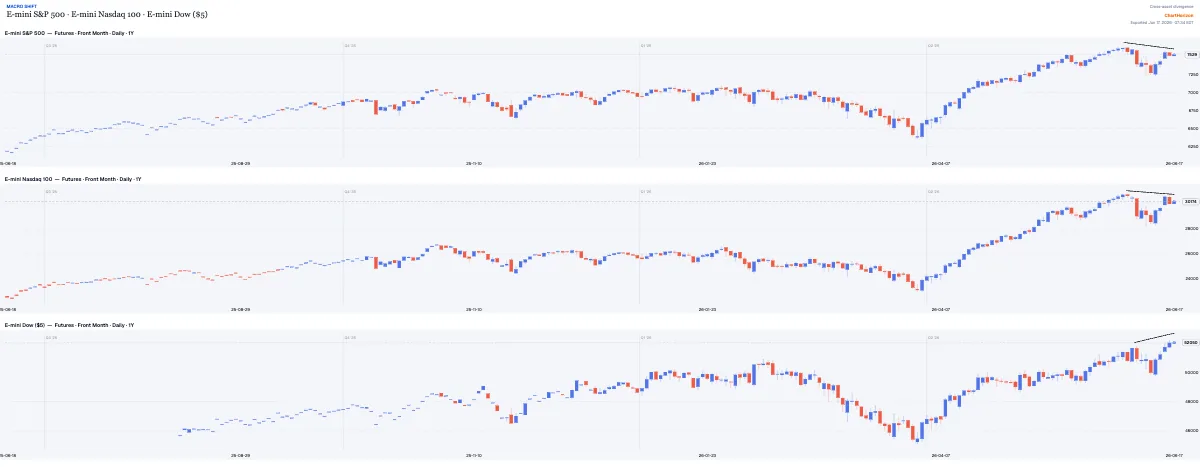
A healthy advance is signed by every leader at once — that was the whole virtue of the move off the April low, straight and broad and undersigned by none. Look at the three now and the signatures have begun to thin. The S&P 500 at 7529 has made a lower high and turned down beneath a descending line drawn over the very top. The Nasdaq 100 near 30,100 has done the same — the fast money’s index, the one that ought to lead a true risk-on charge, instead rolling over first under its own descending line. Only the Dow, near 52,000, has pressed on to a marginal new high, and it now stands very nearly alone in doing so.
The crowd reads that new high in the Dow as strength. I read it as narrowing. When the broad index and the growth index both make lower highs while the heaviest, slowest name carries the tape up by itself, the advance is not being confirmed — it is being carried, on fewer and fewer shoulders. New highs made by one leader while the others quit is the oldest tell of distribution there is: the averages diverge at the top because the buying that built the move has begun, quietly, to become selling. A top is not a moment; it is a process, and this is what the early part of the process looks like on the tape.
The bond board stops agreeing
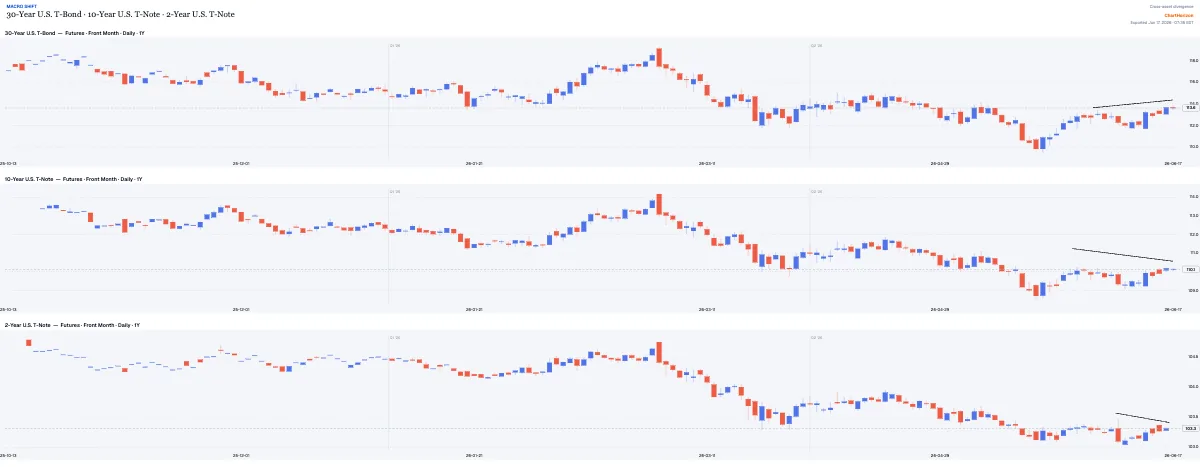
Read the bond board the same way — the group, not the single quote — and it is telling a story the stock crowd is not yet listening to. These three maturities normally move as one family. Here they have split. The 30-year T-Bond, near 93.8, has stopped falling and turned up, climbing a rising line drawn under its recent lows. The 10-year, near 110.3, and the 2-year, near 103.0, have done the opposite — each slipping beneath a descending line over its highs. The long end is being bid while the front and the belly are sold.
Now, the long bond is the market’s truest instrument of fear — the thing money runs to when it begins to doubt the future and to want duration and safety in its hands. For that instrument to be quietly accumulated while stocks make new highs is two markets telling two different stories at the same hour, and when they disagree it is usually the bond market that has read the next chapter first. A bid for protection rising under the surface does not belong beneath a healthy risk-on advance. It belongs beneath a tape that is preparing, in its slow underground way, to go the other direction. The bond board has begun to whisper risk-off while the stock board still shouts risk-on — and I have learned to trust the whisper.
The Dow’s own confession
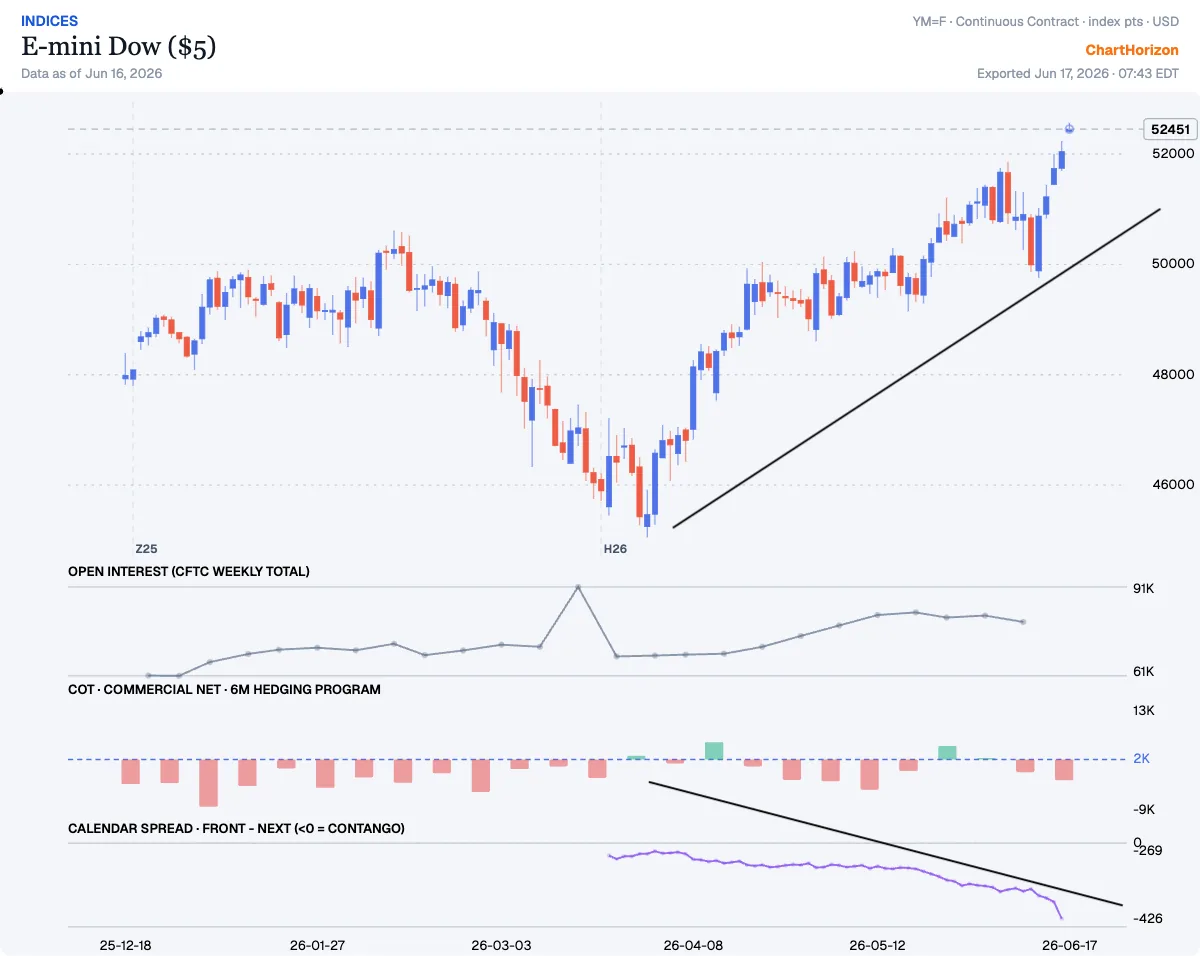
Then take the leader itself — the one name still making new highs, the Dow at 52,451 — and put its own internals beneath its own price, and you find it confessing against itself. The price rides a steep rising line straight up off the H26 low, as clean a trend as the board offers. But drop to the bottom pane, to the calendar spread — front month minus next, where anything below zero is contango — and you see it doing the exact reverse: deepening from around −269 down to −426, a descending line falling away beneath a price that is climbing. That is the divergence that matters most, because it comes not from a chart I drew a line on but from the structure of the contract itself.
A rising price with a deepening contango is a market making new highs while the men who must actually carry the position grow less willing to pay up for the here-and-now and more content to let the front month sag against the deferred. The urgency is draining out of the very contract that is printing the high. Glance up one pane and the rest agrees: open interest has rolled off its 91K spike and drifted, no fresh crowd rushing in to power the breakout; the commercials — the hedgers, the people who handle the real thing — sit net short into the advance, as the red of the program plainly shows. New high in price, falling spread, flat-to-easing interest, hedgers leaning the other way. The tape is making its high with one hand and selling it with the other. This is the advance the market will not sign — and an unsigned advance is, as often as not, a fake one.
The read — sell the break, not the high
Put the three together and the verdict is harder than last week’s, because the condition I set last week was never met and the evidence has since piled the other way. The dollar never broke, so the bull case never earned its confirmation; the leaders have stopped confirming each other; the bond board is bidding for safety under the surface; and the Dow is making its high on a hollowing structure with the hedgers selling into it. I do not believe this advance. I think the late buying is the public’s, the late selling is the smart hand’s, and the new high is the bait on the hook.
But understand the discipline, because the discipline is the whole of the edge. A divergence is a warning, not a signal. I do not short a market merely because it has diverged — to sell a strong tape short on a hunch is the same blunder as buying a weak one on hope, worn inside out, and the market has stayed irrational longer than that error can stay solvent. The market is never wrong; my reasons can be. So I will not short the high. I will short the break — and I will let the tape hand it to me. The pivotal points are drawn already and they are simple: the Dow’s steep rising line and the reaction lows beneath this whole top; the S&P and Nasdaq, which have only to extend the lower highs they have started; and above all the dollar, whose failure to break is the cap holding firm, so that the day the leaders give way the wind itself reverses. Let the rising lines give. Let the Dow lose the trend it is riding and the others lose their floors. Then the divergence becomes a trend, the warning becomes a position, and the line of least resistance points down — and I will sit on the short side with the wind at my back the same way I sat on the long.
Until that hour, the position to hold is cash, and cash is a position — frequently the strongest one on the table. The hollow advance may yet make another high; hollow things often do, right up until the floor goes. I am not selling the high and I am not buying it. I am standing flat with the lines marked, waiting for the tape to stop confessing and start confirming — and the way every part of this board is leaning, I do not think the wait will be a long one.
Informational and educational only — not financial advice. Futures trading involves substantial risk of loss; seasonal and positioning signals do not guarantee future results. Signals and charts: ChartHorizon (local end-of-day data).