The Cheaper Instrument
Tokyo spent ¥15.39 trillion in a month, the largest ever recorded. On 3 September the yen gained 2.18 per cent with no official money behind it.
Prices through 4 September 2026 · COT through the 1 September report · a currency note · Data: ChartHorizon, CFTC & press reports · Charts: ChartHorizon
There are two ways for a government to buy its own currency. It can buy the currency, or it can change the reason people sell it. The first is an operation, the second is a policy, and this summer has now priced both of them within five weeks of each other.
The first cost ¥15.39 trillion — about $98bn — and it is the largest month of yen buying in the history of the exchange. It bought a flat line.
The second cost a sentence, and it moved the market more in one session than the record month managed in four weeks.
The receipt
The chronology is worth setting out cleanly, because the numbers in it are now official rather than estimated.
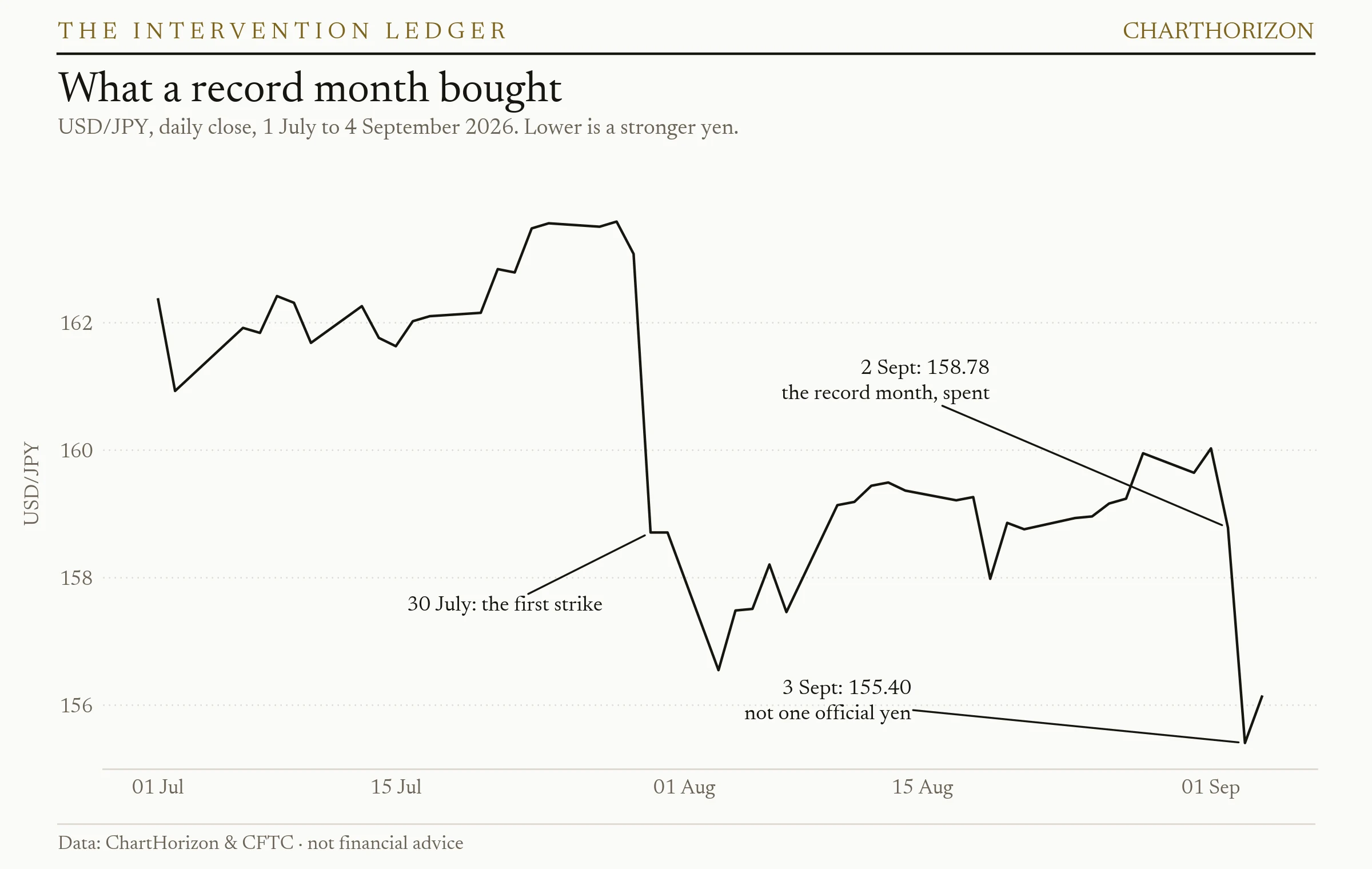
On 23 July the dollar traded at 163.67, the weakest the yen had been since 1986. On the night of 30 July the Ministry of Finance intervened and the dollar fell about five yen, closing at 158.70 — a 2.76 per cent day in the yen and still the largest of 2026. On the following night Washington joined, an event Tokyo’s own press dated as the first coordinated operation in twenty-eight years. (This desk wrote first since 2011 at the time. Both are defensible: 2011 is the last multilateral G7 action, 1998 the last bilateral one. The Japanese count is the stricter of the two and the better one to use.)
Then, on 28 August, the Ministry published the tally for the reporting window running 30 July to 26 August: ¥15.39 trillion, against a previous monthly record of ¥11.73 trillion set in the April–May window of this same year. Not a large month. The largest month there has ever been, by thirty-one per cent.
Here is what it bought. The dollar closed the night of the first strike at 158.70. On 2 September — the record spent, the window closed, the receipt filed — it closed at 158.78.
Eight sen the wrong way. Four weeks, ninety-eight billion dollars, and the market ended fractionally further from where the Ministry wanted it than it had been before the money was spent.
The other instrument
On Thursday 3 September the yen rose 2.18 per cent, closing at 155.40 and touching 155.21 intraday — its best level since 3 August and the third-largest up-day of the year, behind only 30 July and 30 April. It traded 428,747 contracts, the heaviest session in the front contract since it rolled on 17 August.
No money was spent. Analysts looking for the signature found none: there was no dislocation in the electronic matching systems of the kind an operation leaves behind, and the move ran through the session rather than arriving in one block after hours. What had happened instead was that on 2 September Governor Ueda signalled the chance of a hike at the 18 September meeting, saying the Bank had come to believe it must pay greater attention than before to upside risks as underlying inflation approaches two per cent. He was not alone. At least three of the nine board members have now argued the Bank could raise faster than its current pace of roughly two increases a year, and the American Treasury Secretary has spent the summer publicly asking for the same thing. By Thursday the market had a September move close to fully priced.
That is the whole of it. A committee changed the emphasis of a sentence, and the yen did in six hours what ninety-eight billion dollars could not do in four weeks.
The reason is not mysterious, and it is the only piece of theory in this note. An intervention buys the price. A rate expectation buys the reason for the price. Nobody is short the yen because the yen is cheap; they are short it because it is cheap to borrow, and the cost of carrying that short is paid every day out of the differential. The Ministry of Finance cannot touch the differential. It can only make one evening’s borrowing painful and then stop, and a market that has been leaned on for a year is very good at waiting out an evening. The Bank of Japan sets the number the trade actually pays. Which is why the expensive instrument moves the price and the cheap one moves the position.
It was not the dollar
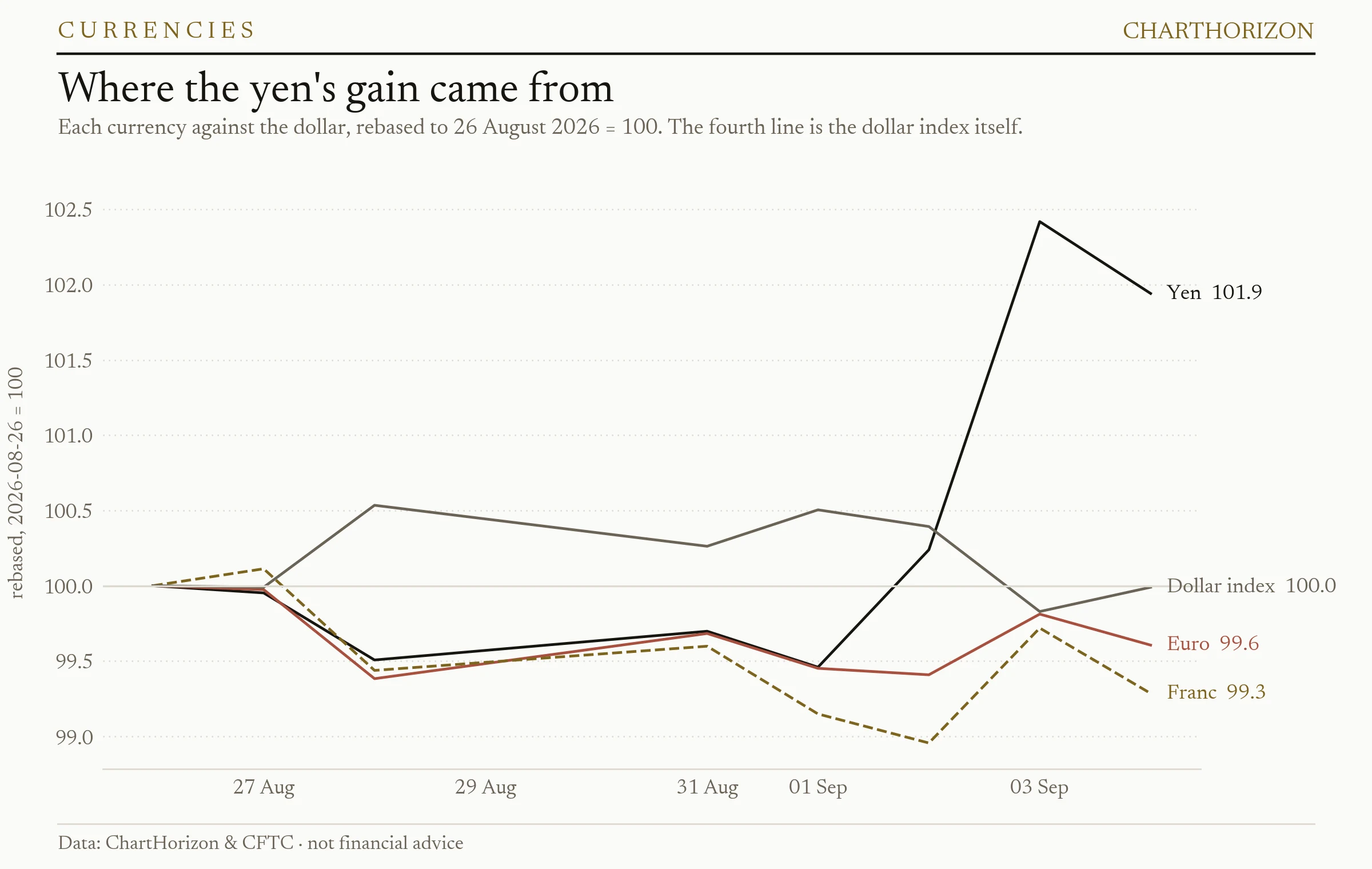
The obvious objection to all of the above is that the dollar simply had a bad week and the yen was carried along with everything else. The tape says otherwise, and says it flatly.
Measured from 26 August, the day the Ministry’s reporting window closed, the yen is up 1.94 per cent against the dollar. Over the identical span the dollar index is down 0.01 per cent — unchanged to the second decimal. The euro is down 0.39 per cent and the Swiss franc down 0.72.
So this was not a dollar move. The dollar went nowhere; the yen went up and the other two funding currencies went down. Money did not leave the carry trade. It moved one seat along the bench, which is what it did in August when it refinanced out of the yen and into the euro, and which it is now doing again, one currency further down the rate table. This desk’s own strength board has the franc as the weakest of the eight majors at −4, and the arithmetic behind that is not sentiment: the Swiss National Bank’s policy rate is 0.00 per cent against the Bank of Japan’s 1.00, and a Japanese hike on the 18th widens that gap rather than closing it.
That matters for a reason beyond bookkeeping. On 18 August this note set out two things that would tell us the yen trade had genuinely begun to end. The first was that the cheapest money in the developed world should become unambiguously Swiss rather than Japanese. Three weeks later, on the desk’s own board and in the published policy rates, it has.
The book was already there
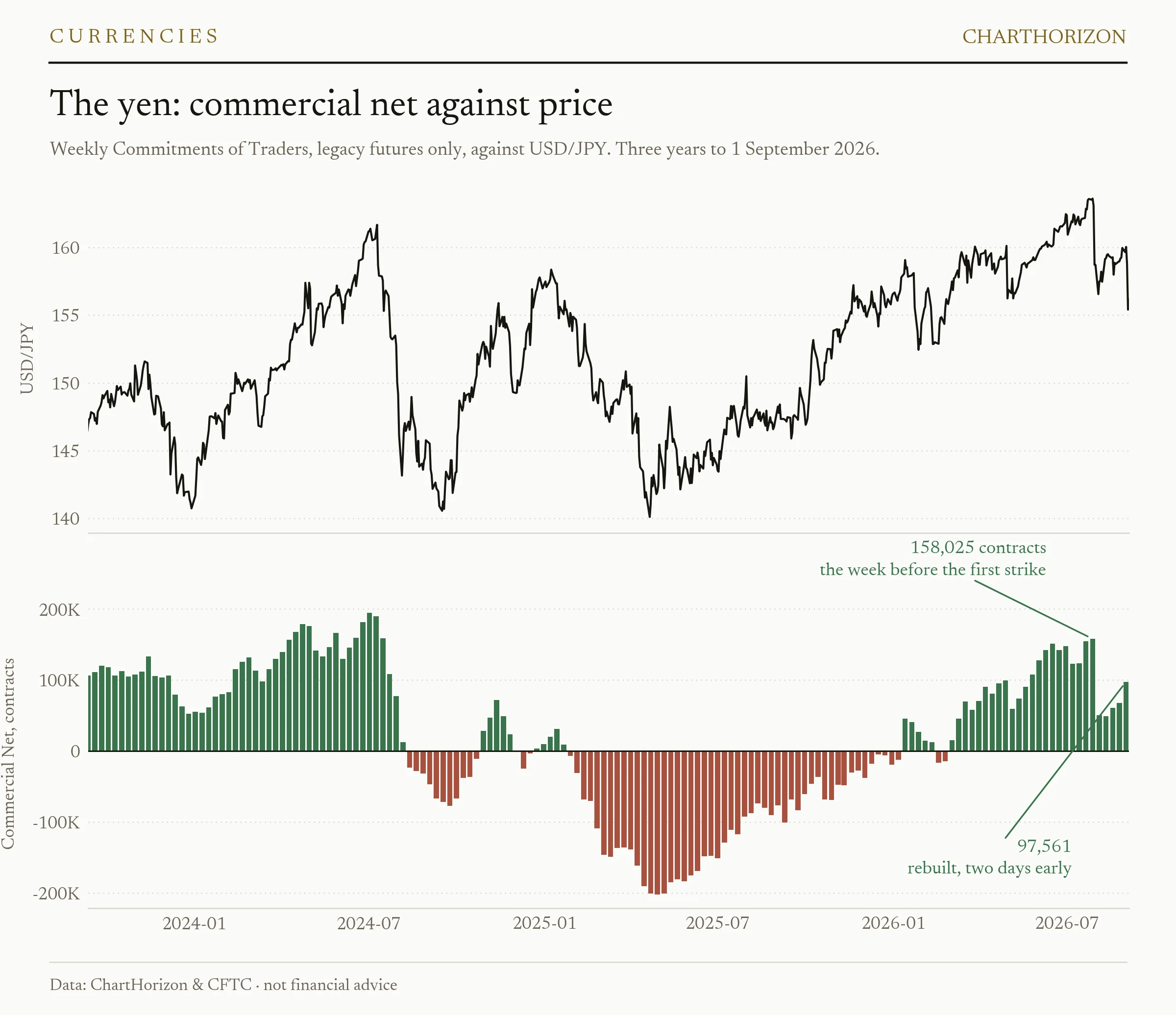
The second test was more specific: a commercial book that starts climbing again from the 35th percentile, while price is still weak, would say the same people who just sold are willing to pay to be long again at a worse level.
| CFTC report | Commercial net long | Open interest |
|---|---|---|
| 28 Jul 2026 | 158,025 | 432,366 |
| 11 Aug 2026 | 48,769 | 391,874 |
| 18 Aug 2026 | 61,074 | 380,811 |
| 25 Aug 2026 | 67,837 | 384,216 |
| 1 Sep 2026 | 97,561 | 411,882 |
Three consecutive weeks of building. From 48,769 contracts to 97,561 — the book has been almost exactly doubled, and it is back at the 70th percentile of every weekly report on the file. And look at what the price did while they were doing it: the dollar closed the 11 August report at 159.19 and the 1 September report at 160.03. The yen did not firm during the rebuild. It got weaker, and they bought it anyway, at a worse level than the one they had sold — which is the precise condition the August note named.
The detail that matters most is in the right-hand column, and it is the mirror image of the one that damned the August reports. When these hedgers dumped 109,000 contracts in the fortnight after the intervention, open interest fell — the position was closed, not transferred, which is what told us the squeeze had been spent rather than passed to someone else. Since the 18 August low, open interest has risen by 31,071 contracts. New longs against new shorts. This is accumulation, not somebody being bought out of a losing position.
And the date on that report is Tuesday 1 September. The move came on Thursday the 3rd. Two days.
I want to be careful about what that does and does not establish, because it is easy to make this sound like foresight and it is not. The commercials are not forecasters; the same file has them early by months and occasionally wrong outright, and this desk has said so in the middle of a bullish reading before. What the sequence establishes is narrower and more useful: the people whose business is the physical currency spent three quiet weeks positioning for the rate story while the rest of the market was still watching the Ministry of Finance’s cheque book. They were reading the cheaper instrument.
What this does not mean
It does not mean the yen has turned. On the strength board dated 5 September the yen still scores −1.1 — third weakest of the eight majors, ahead of only the franc and the New Zealand dollar. A currency does not become strong by having one very good Thursday.
Nor is a September hike the end of anything. The Bank of Japan is at 1.00 per cent. The Federal Reserve is at 3.50–3.75. Twenty-five basis points takes a gap of 2.63 percentage points to 2.38, and a trade that has been paid two and a half points a year to stay short does not close because that becomes two and a quarter. The differential is the mechanism, and the mechanism is still overwhelmingly intact. What has changed is its direction, which is the part markets price long before the arithmetic gets there.
There is also a fair defence of the Ministry to be made, and it should be made. The record month did not buy a level, but it plausibly bought the time in which the rate expectation could form — it kept the dollar from running through 165 while the board’s opinion turned, and a currency in disorderly retreat is a much harder thing for a central bank to act into calmly. Judged as a holding action rather than a reversal, ¥15.39 trillion looks less like failure and more like expensive patience. It is worth noting that Tokyo has quietly arranged for the next round to be funded through the Federal Reserve’s FIMA repo facility rather than by selling Treasuries, which is a considerate thing to do to a long end that spent the summer coming apart — and an admission that they expect there to be a next round.
The read
Both of the tests this desk set out three weeks ago have now been met, and they were met in the order the theory predicted: the funding advantage moved to Switzerland, and the hedgers began paying up to be long the yen at a level no better than the one they sold. Neither of those things required an intervention, and neither of them was caused by one.
So the position to hold is this. The trend is not yet broken — 163.67 stands, the yen is still in the bottom half of the board, and one session does not undo a year. But the market has now demonstrated, in public and within a week, what the two available instruments actually cost. One of them is ¥15.39 trillion for eight sen in the wrong direction. The other is a change of emphasis from a governor, and it is worth two per cent.
The 18th of September is the next reading, and the interesting question is no longer whether the Bank moves. It is whether the yen holds its ground in the sessions after it does, with no official bid underneath and the whole of the move already priced. That is the test a trend change has to pass, and it is the only one left that has not been taken.
Watch the book while you wait. A commercial long that keeps climbing through the meeting is the same signal, given a second time, by people who have already been right once this month.
Informational and educational only — not financial advice. Futures trading involves substantial risk of loss; seasonal and positioning signals do not guarantee future results. Signals and charts: ChartHorizon (local end-of-day data).