The Weekly Tape — the yen did not turn, it was turned
Tokyo spent an estimated ¥8.45tn in one night and Washington joined for the first time since 2011. But the hedgers were already 96th-percentile long.
Prices through 31 July 2026 · COT through the 28 July report · a currency note · Data: ChartHorizon & CFTC · Charts: TradingView
There is no market so friendless as the one everybody uses and nobody wants. For a year the yen has been exactly that — not an investment but a utility. The world’s cheapest money, borrowed in order to be sold, the loose change funding every crowded long from Sydney to Chicago. A currency in that office does not decline because the country behind it is failing. It declines because it is useful declining, and because the whole street has learned it can be leaned upon without consequence.
Last week the leaning stopped — but not because the market changed its mind. It stopped because two governments put their hands on the scale, and one of them had not touched this market in fifteen years.
The two nights
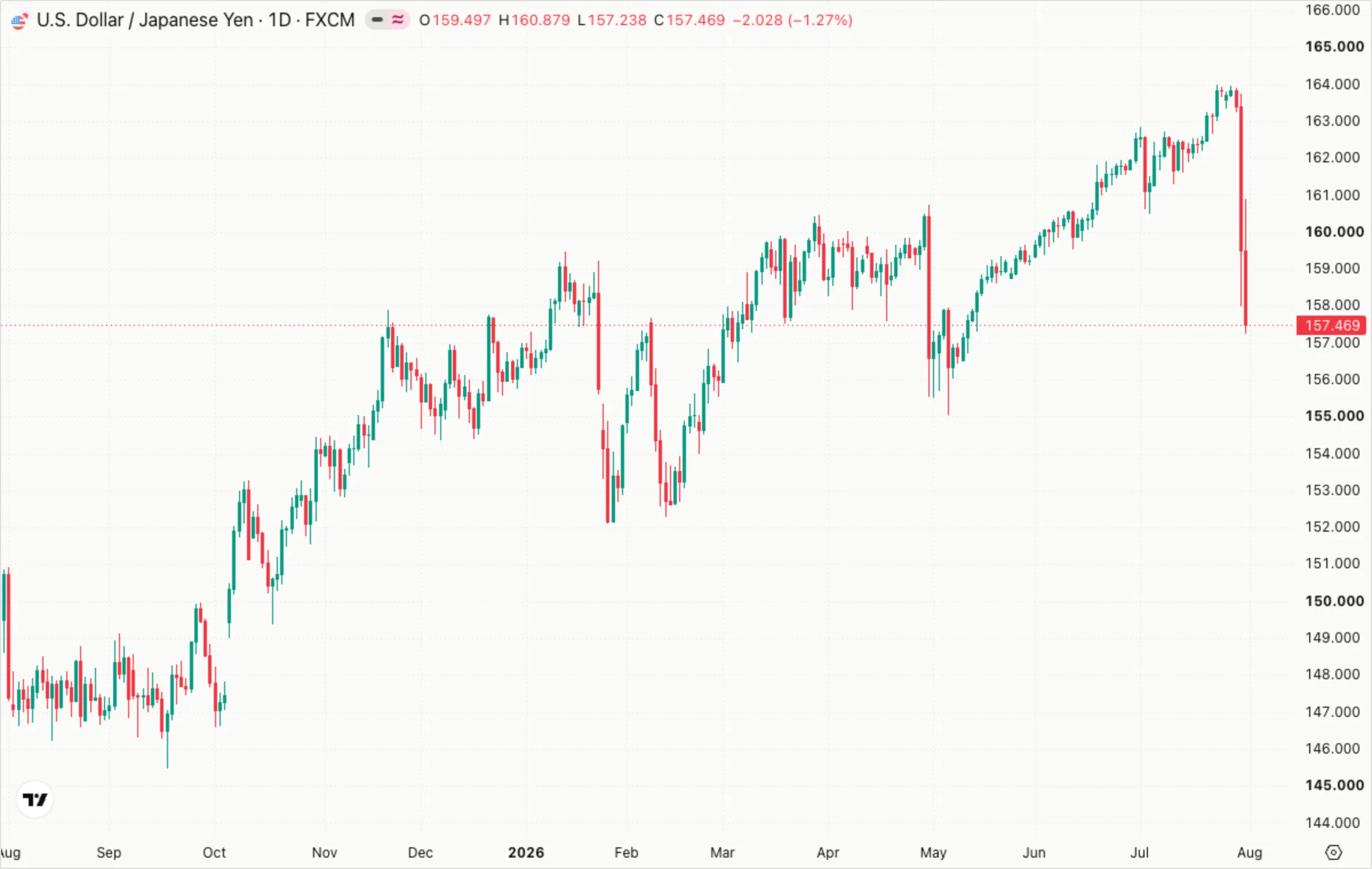
For twelve months this was the easiest picture in the market. From about 147 last August the dollar climbed against the yen in the manner trends of this kind always climb — not in a rush, but in a staircase: three steps up, one small step back, no step back ever quite undoing the three. Such a chart makes converts. It rewards the man who stops thinking and simply holds, and it goes on rewarding him right up until the day it doesn’t.
It carried to 163.95 — the weakest the yen has been against the dollar since 1986, a four-decade low, and in the twenty years of continuous futures this desk keeps, the ten cheapest closes on the whole file all fall inside the past five weeks. That is the number that finally made the move political. A currency at a forty-year low is no longer a market story in Tokyo; it is an import-price story, and with the energy shock from the Iran war already running through the cost of living, a weak yen had stopped being an export subsidy and started being a household tax.
So on Thursday night the Ministry of Finance stopped talking. At around half past ten Tokyo time, in thin New York hours, the yen went from about 162.80 to the 157 handle inside a single hour. Nikkei called it a massive yen-buying operation; the Bank’s own current-account data, as read by Bloomberg, put it near ¥8.45 trillion — roughly $53 billion, the largest single day Tokyo has ever spent. The dollar closed Thursday at 159.22.
Friday brought the part that actually matters. Japan came back for a second consecutive day — and this time Washington came with it. The Financial Times reported that the Federal Reserve Bank of New York sold euros for yen on behalf of the U.S. Treasury, executing through Goldman Sachs and Morgan Stanley. The dollar dropped from about 158.9 to 157.6 in minutes. It is the first time the United States has intervened in this currency since 2011, when the G7 acted together after the earthquake and tsunami. Treasury Secretary Bessent would say only that Japan “may have” intervened; the Ministry and the New York Fed declined to comment at all. A photographer got a picture of Bessent’s notepad. It read: Buy Japanese Yen (JPY) $5–10 bil.
Two sessions, six and a half yen, in a market whose entire year had been made of quarter-yen steps. In the futures, Thursday was the largest single-day advance in the yen in three years — bigger than anything printed during the unwind of 2024.
What kind of week that was
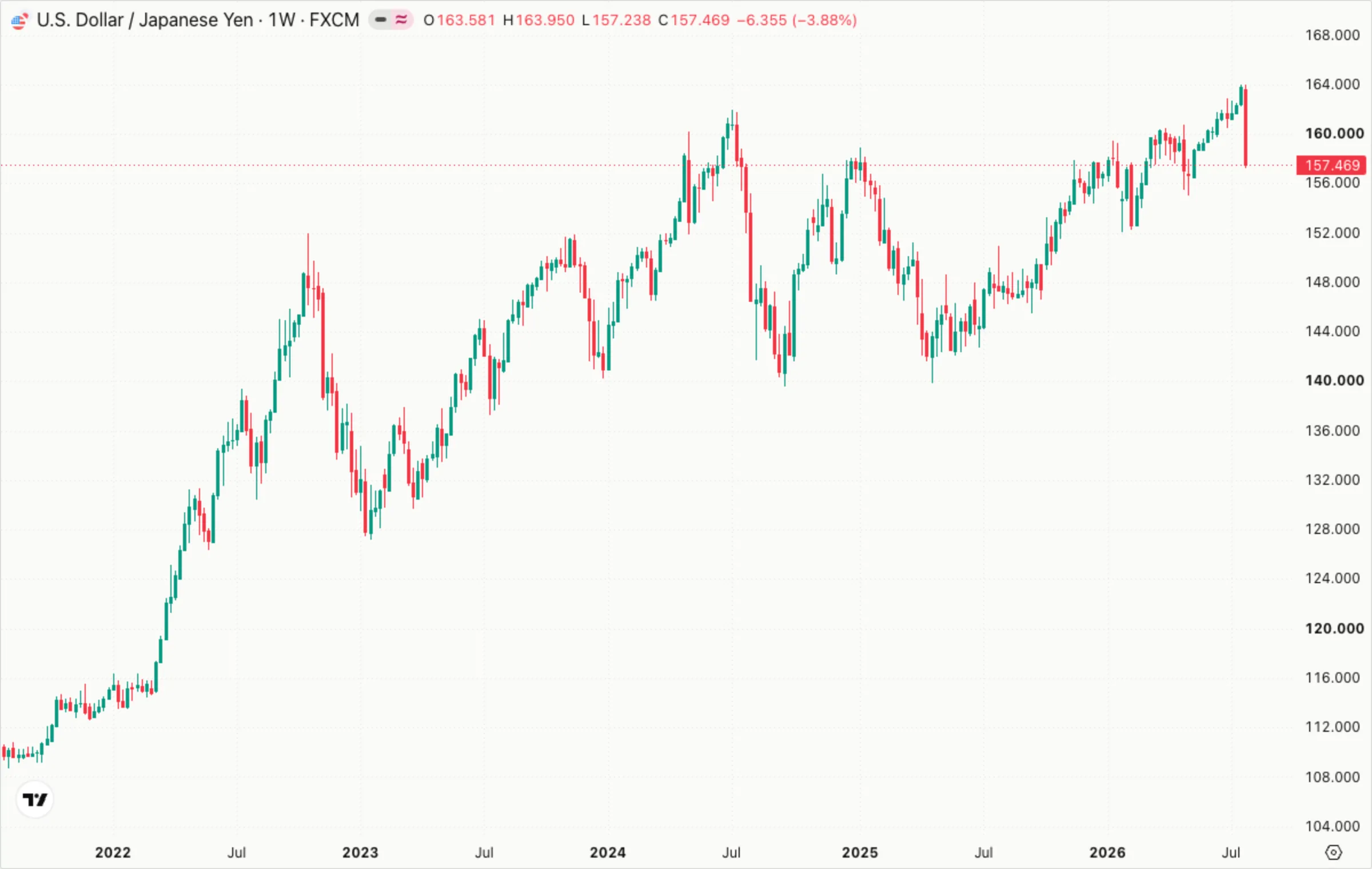
Step back to the weekly bar and the shape states itself plainly. The week opened at 163.58, made the high of the entire twelve-month move at 163.95, and closed at 157.47 — down 3.88 per cent, within a quarter of a yen of the lowest price it traded all week.
In any other week I would call that a key reversal and mean something by it. A market that posts the high of its whole advance and then surrenders the week’s full range to close on the floor has not had a correction; it has had a change of hands. But honesty about who did the buying is the whole of this week’s analysis. The supply that had been absent for a year did not finally arrive from the market. It arrived from the Ministry of Finance and the U.S. Treasury, and it arrived because a policy threshold was crossed, not because a valuation was.
That distinction is not academic, and the reason sits in this year’s own record. In late April and early May, Tokyo spent a then-record ¥11.7 trillion — about $73 billion — defending this same currency. The gains were wiped out within weeks. It intervened again on 11 July to the tune of $20.7 billion; the yen made new lows a fortnight later. A chart pattern is a photograph of who won an argument. When one side of the argument is a central bank with a printing press and a mandate, the photograph tells you far less about tomorrow than it usually does.
So I will not sell you Friday’s candle as proof of a turn. What I will say is that a reversal drawn by an official hand still leaves a real mark on a real book — and the book was already leaning.
The ledger the crowd does not read
Here is the fact that survives everything above, and it is the reason this week is worth more than the last three interventions put together.
The Commitments of Traders report that matters is dated 28 July — two days before the first yen was bought. It shows the commercial hedgers already long the yen with both hands.
| CFTC report | Commercial net long | Open interest |
|---|---|---|
| 12 May 2026 | 74,143 | 362,042 |
| 2 Jun 2026 | 127,768 | 505,555 |
| 30 Jun 2026 | 148,087 | 438,825 |
| 14 Jul 2026 | 123,418 | 396,514 |
| 21 Jul 2026 | 154,898 | 423,796 |
| 28 Jul 2026 | 158,025 | 432,366 |
Note what that column does not do. It does not fall while price falls. Through eleven weeks in which the yen went from cheap to cheapest-in-forty-years, the hedgers’ book more than doubled — and it grew into rising open interest, which is the detail that separates real accumulation from bookkeeping. New money took that side. It was not shorts covering into a quiet market; it was fresh contracts opened against the direction of the tape, before any official bid existed to reward them.
At 158,025 net long, that book sits at the 96th percentile of every weekly report since the record begins in June 2021. Only nine reports in five years have ever shown the commercials longer the yen than they are right now — and all nine of them fall inside a single stretch of calendar: April to July of 2024.
It is worth remembering how that stretch ended, because the sequence is the lesson. The commercial long peaked at 194,545 contracts on 2 July 2024, with the dollar around 161 yen. Tokyo intervened in mid-July. Then, on 31 July 2024, the Bank of Japan raised rates — and a soft U.S. payroll print followed two days later. That combination did what no intervention had managed alone: the dollar was at 143 within five weeks, and the Nikkei fell twenty per cent in three sessions, its worst since
- The hedgers sold the entire rally into the hands panicking to buy it back, cutting from 194,000 to 12,000 contracts by 6 August and flipping outright net short a week later. They were not prophets. They were positioned before the move and paid during it, which is the only kind of foresight the market actually compensates.
Intervention did not turn the yen in 2024. It lit the fuse. Policy and positioning burned it.
The cross that pays for it
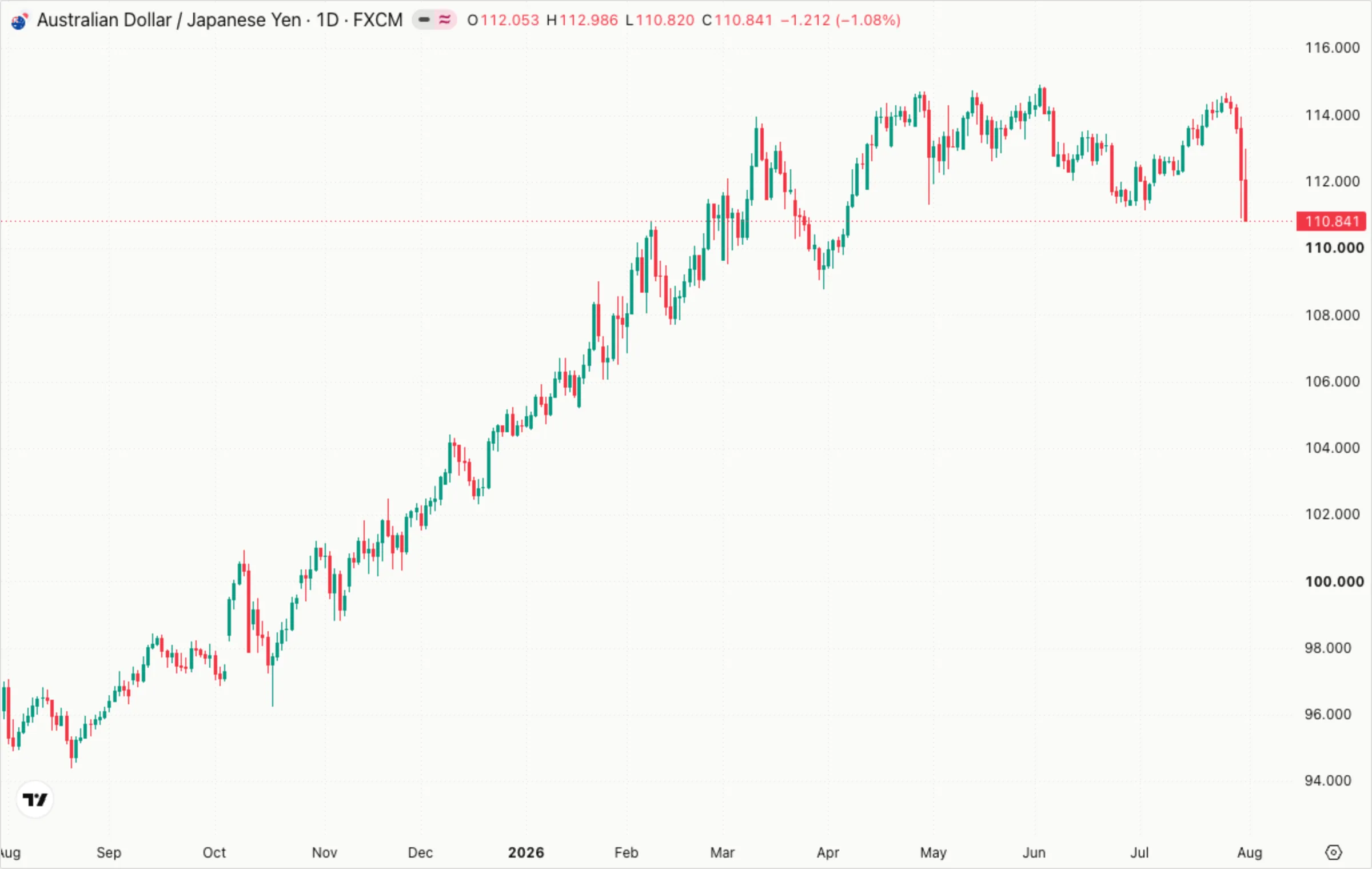
To see what is actually at stake, look past the dollar to the cross where the yen’s job is most naked. The Reserve Bank of Australia holds its cash rate at 4.35 per cent; the Bank of Japan holds the overnight call rate at 1.00. Three and a third points, paid to you for doing nothing but staying in the trade — and a chart that ran from the mid-90s to better than 115, a twenty per cent capital gain stacked on top of the interest. That is the carry trade entire: you are paid to wait, and the waiting has been going up.
Friday it closed at 110.841, off 1.08 per cent and some four yen from the July high. The first real crack in the most comfortable trade in currencies.
And here is the tension worth sitting with. ChartHorizon’s own strength board, dated 1 August, still ranks AUD/JPY the second-most bullish pair on it at Bull +4.1 of 12, with the Australian dollar the strongest currency on the board at +4 and the yen still on the weak side at −0.1. The board is not wrong. It measures the trend that has been, and that trend is genuinely, measurably intact. The tape measures what is happening now. When the two disagree the honest reading is never “the board is broken” — it is that the board has not yet been asked the question the Ministry of Finance asked on Thursday night.
One quieter tell sits in the same table. The only cheaper funding currency in the developed world is the Swiss franc at zero — and on the same board the franc is the weakest currency at −1.0, with CHF/JPY listed among the bearish pairs. Between the world’s two funding currencies, the yen has already stopped being the loser. That is a small thing. Small things are what the front of a turn is made of.
The read
The yen is not in a bull market, and an intervention is not a trend. Let me be plain about that, because the temptation after a violent week is to promote a bounce into a new era. The line of least resistance has run one way for twelve months, and two nights of official buying do not repeal twelve months. This same government spent a bigger sum in April and had it taken away inside a month. Anyone who buys the yen purely because the state is buying it has entered a partnership in which he is the junior party and cannot see the books.
What has changed is not the trend. It is the number of things now standing in the same place at the same time — and two of them are genuinely new.
The first is the company Tokyo is keeping. The analysts’ standing objection to every intervention this year has been that Japan can slow a move but cannot turn one without a shift in U.S. rates or help from Washington. On Friday, help from Washington arrived — the first American operation in this currency since 2011. A unilateral intervention is a subsidy for the shorts. A coordinated one is a statement about what the G7 will tolerate, and markets have historically extended it a good deal more respect.
The second is the ledger. The commercial book was at the 96th percentile of five years before the first yen was bought. Intervention fired into a crowded, one-sided, profitable short is how a squeeze starts; intervention fired into a market that is not positioned is merely an expensive gesture. Every failed defence this year was the second kind. This one is the first.
And what is missing is the piece that did the real work in 2024. On Friday the Bank of Japan held at 1.00 per cent, and Governor Ueda offered the currency nothing fresh. In 2024 the rout required a hike, not a defence. The Bank did say core inflation is likely to run “clearly above” two per cent from the second half of the fiscal year, and most economists polled by Reuters look for 1.25 per cent by year-end — so the fuse exists. It is simply not lit yet.
That gives a watch-list rather than a position, which is the correct thing to hold at this particular hour. Let the dollar fail to reclaim 160 and roll over into a lower high, and the reversal begins to build a structure instead of a single official bar. Let AUD/JPY lose the shelf around 110, and the carry crowd is no longer defending — it is liquidating, and liquidation feeds itself. Above all, let the next COT reports show the hedgers holding that long rather than quietly selling it into the government’s bid, because a commercial book that stays heavy while price rallies is a different animal from one that lightens into strength. And watch the Bank, not the Ministry: the day the market prices 1.25 per cent as a certainty is the day the 2024 sequence has assembled its last piece. Equally, let the dollar grind back over 161 and print a new high, and last week joins April and July on the list of expensive gestures.
The pivotal point has been reached. That is all that can honestly be said today — and it is not nothing, because the pivotal point is where every move of importance begins and also where every false alarm goes to die. Governments can buy a currency. They have never yet bought a trend. What they can do is choose the hour at which an overcrowded position must finally justify itself, and they have chosen it. The trend still says one thing and the ledger says another; the tape has begun to argue for the ledger, and it has not yet finished the sentence. There is no prize for guessing the ending, and no penalty at all for waiting to read it.
Informational and educational only — not financial advice. Futures trading involves substantial risk of loss; seasonal and positioning signals do not guarantee future results. Signals and charts: ChartHorizon (local end-of-day data).