Where the Metal Went
COMEX gold stocks fell from 45.1m ounces to the middle twenties. The Shanghai premium stayed flat: what moved east was the bid, not the bullion.
COMEX stocks through 31 July 2026 · COT through the 28 July report · WGC Q2 demand · Data: ChartHorizon, CFTC, World Gold Council · Charts: ChartHorizon
There is a number the gold internet has been reciting for eighteen months, and it is true. In early April of 2025 the COMEX warehouses held 45.1 million ounces of gold. Today the combined registered-and-eligible pile is somewhere in the middle twenties of millions of ounces, depending whose daily count you take, and the registered portion — the metal that actually carries a warrant and can actually be delivered against a futures contract — stood at 14.51 million ounces on 31 July, down 3.8 per cent in thirty days.
That is a genuine drain, and it has been going on long enough that nobody can call it noise.
The explanation attached to it is where the trouble starts. The explanation is that Asia is buying the metal away — that Shanghai bids a premium, that the arbitrage pulls bullion out of New York and onto a plane, and that the West is being quietly stripped of the physical while it plays with the paper. It is a satisfying story. It has a villain, a mechanism, and an implied trade.
It also has a problem. If Asia were bidding the metal away, there would be a premium. There isn’t one.
The pile that was never supposed to be there
Start with how the gold got to New York in the first place, because the drain does not make sense until you know what is draining.
In the winter of 2024–25 the market decided that the incoming American administration might put tariffs on bullion. Nobody knew whether it would. That was precisely the point: an unhedgeable binary on a metal whose entire function is to be the same everywhere. If a tariff landed on gold, metal already inside the United States would be worth more than metal outside it, and every short who owed an ounce in New York would need to source it domestically at whatever price the domestic market demanded.
So the trade did what trades do with a cheap option. It moved the gold. Roughly 12.2 million ounces were shipped into COMEX warehouses over two months; by late January 2025 something like 393 tonnes had arrived since the election, lifting inventories by nearly three quarters to the highest level since August 2022. The metal came overwhelmingly out of London, and London felt it. Delivery queues at the Bank of England, normally a matter of two or three days, stretched to four and eight weeks. For a few months the world’s deepest bullion market could not get its own gold out of its own vault on schedule.
On 2 and 3 April 2025, the White House excluded gold from the tariff schedule. The option expired worthless. The New York premium over London closed, and every ounce that had flown the Atlantic on a hedge against a tariff that never came became, that afternoon, an ounce sitting in the wrong vault, earning nothing, costing storage.
It has been going home ever since. By the end of April 2026 the LBMA counted 9,372 tonnes in London vaults, about $1.4 trillion — recovered from the 8,477 tonnes of end-February 2025, which had been a five-year low.
Read the COMEX drain against that and the shape changes entirely. A pile that was inflated by seventy-five per cent in ten weeks by a regulatory scare is now deflating. Most of what is leaving is not being torn out of the West by hungry Eastern buyers. It is a stockpile unwinding, going back to where it lived before somebody frightened it across an ocean.
That is the unglamorous half of the answer, and it accounts for a great deal of the number everyone is reciting.
The premium that isn’t there
Here is the test that settles it, and it takes one line.
If bullion were being pulled from New York to Shanghai by demand, the Shanghai Gold Exchange would have to be paying up. Physical does not move across a border out of sentiment; it moves because somebody on the far side is bidding more than somebody on the near side, by more than the cost of the freight, the insurance, the financing and the assay.
On the morning of 30 July 2026 the Shanghai benchmark fixed about five dollars an ounce above COMEX. Over the preceding month the gap ranged from 1.3 per cent below to 1.2 per cent above — it spent the period oscillating around zero, a few dollars of premium one day and a few dollars of discount the next.
Five dollars is not an arbitrage. Five dollars is noise on a four-thousand-dollar ounce. You cannot freight, insure, finance and re-refine metal from a New York vault into a Shanghai deliverable bar for five dollars, and no desk is trying.
So the Chinese buyer is not paying up for gold. Nor is he boycotting it — a sustained discount would say demand had gone away, and there is no sustained discount either. He is simply paying the world price, every day, in size, without drama. After three years in which the Shanghai premium was one of the loudest indicators in the metal, its flatness through the middle of 2026 is its own statement, and the statement is: nothing unusual is happening at this particular border.
Which forces the question into a better shape. If the metal is not being pulled east by price, and the pile in New York is mostly just a tariff-scare stockpile going home — then what, if anything, has actually shifted east?
The answer is that it was never the bullion. It was the bid.
The ounce that changed hands
The World Gold Council’s second-quarter accounts, published for the April-to-June period, contain the real story, and it is not in the vault column. It is in the ownership column.
Total demand came in at 1,269 tonnes — flat against a year earlier. Behind that flat headline the composition tore itself apart:
| Q2 2026 demand | Change vs a year ago |
|---|---|
| Central banks & official institutions | +289 t net, up 62 % |
| Jewellery | −17 % |
| Gold-backed ETFs | −45 t (net redemptions) |
| Total demand | 1,269 t, unchanged |
Now put that beside the price. Gold made its all-time high on 29 January 2026 — 5,586.20 intraday on this desk’s continuous contract — and closed 31 July at 4,049.10. That is a decline of better than twenty-seven per cent in six months. The stated reasons are sound and entirely conventional: the American conflict with Iran drove energy and inflation expectations higher, which drove expectations of Federal Reserve tightening higher, which drove real yields higher — and a metal that pays no coupon is worth less every time the coupon on everything else goes up. The dollar rebounded on the same logic. Investors who had made an enormous amount of money in 2025 took some of it off the table.
Every one of those is a price-sensitive reason to sell, and the price-sensitive holders duly sold: the ETFs redeemed, the jewellery counters emptied, the profit was booked.
And into that decline, official institutions bought 289 tonnes — the strongest second quarter on the record, up sixty-two per cent on the year. Not despite the twenty-seven per cent drawdown. Through it.
The National Bank of Poland took 51 tonnes in the quarter and 82 in the half, moving toward a self-declared target near 700 tonnes. The People’s Bank of China posted its largest reported increase since the fourth quarter of 2023, to 2,346 tonnes. Earlier in the year, bar-and-coin demand had run 474 tonnes in a single quarter, up forty-two per cent, with Asian retail leading it.
This is the shift, and it is worth being exact about what kind of shift it is. Nothing was seized and nothing was cornered. What happened is that over six months a very large quantity of gold moved from holders who owned it because the price was going up, into the hands of holders who own it for reasons that have nothing to do with the price at all. A pension fund’s gold ETF position is a position. A central bank’s tonnage is a policy.
Metal that moves from the first kind of hand to the second kind does not come back to market on the next rally. It has left the float. That is a far more consequential migration than anything happening to a warehouse receipt in New York, and it does not show up in any vault report, because the metal need never move at all — much of it simply gets re-titled where it already sits.
The rule nobody reported
Then, on 28 June 2026, the part of this story with actual geopolitical teeth — and it arrived, as these things usually do, as a dull consultation document.
The People’s Bank of China, jointly with the General Administration of Customs, published draft revisions to the rules governing the import and export of gold. The stated purposes are the usual ones: streamline administration, facilitate trade, align the framework with current conditions. Read the specifics and something more interesting is going on.
The draft removes the provision requiring the PBoC and customs to jointly formulate the rules for gold carried or mailed across the border by individuals — that traffic stays under customs supervision, but the central bank steps out of the arrangement. Alongside a revision earlier in the year, licensed entities hold permits valid for nine months, during which they may run an unlimited number of qualifying import or export transactions, across an expanded network of approved ports. In exchange, customs supervision is tightened at the front end: clearer scope, closer oversight of agents, a firmer penalty regime.
Note what that is and is not. It is not liberalisation in the Western sense — the state has not let go of anything. What it is, is a transfer of the chokepoint: away from monetary-policy discretion at the central bank and toward routine, permanent, high-throughput customs administration. The PBoC’s grip loosens; the plumbing widens; the flow becomes ordinary rather than exceptional.
Countries build that kind of plumbing when they intend to use it. And the reason to intend to use it is the same reason official gold demand has run at these levels for four years running, and it is not a market reason at all.
Since 2022 every reserve manager on earth has known something he could previously treat as theoretical: that a sovereign’s holdings of another sovereign’s paper can be frozen by decision. A Treasury bill is a claim on an institution that may one day be instructed not to honour it to you. Gold in your own vault is not a claim on anybody. It pays nothing, and in return it cannot be switched off. For most of the post-war period that trade-off was a poor one, because the yield was real and the freeze risk was hypothetical. Both halves of that sentence have now inverted, and the buying reflects it — Asian and Middle Eastern institutions doing the majority of the accumulating, Western European holdings broadly static.
So the eastward shift is real. It simply is not a shift of bullion between vaults. It is a shift in who the marginal holder is, why he holds, and whose infrastructure he uses to move it — and the third of those is what the June draft is quietly building. A world in which the metal can be priced in New York but cleared, stored, licensed and moved without needing New York is not built by draining a warehouse. It is built by writing customs regulations.
What the ledger says
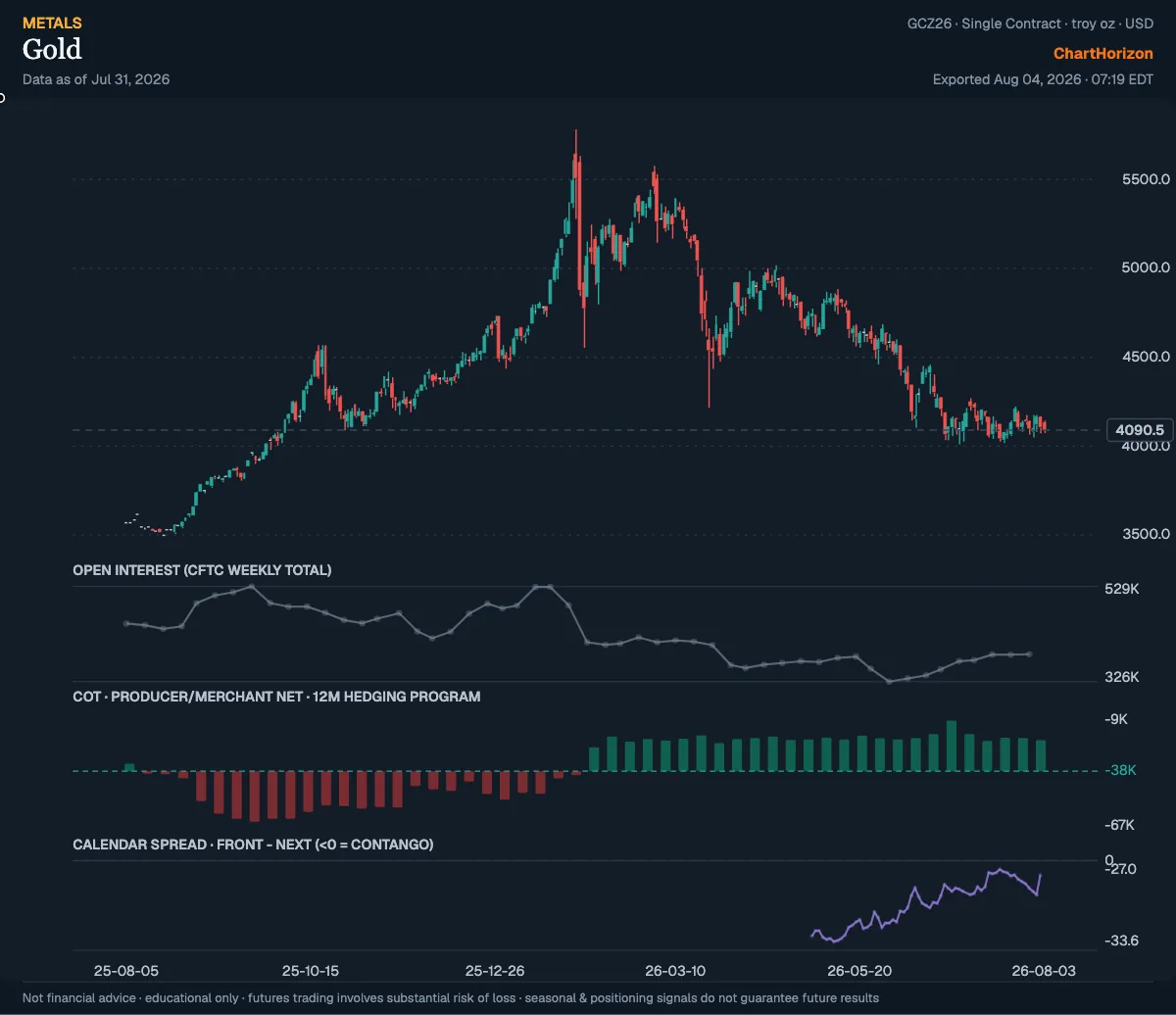
Now to the part of this that is this desk’s own arithmetic rather than anybody’s narrative, because there is a reading in the positioning data that fits the above uncomfortably well.
The Commitments of Traders report of 28 July puts the gold producer/merchant category at 20,549 contracts net short. In isolation that means very little — producers are structurally short, because that is what hedging a mine is. What matters is where it sits in its own history. Across the 269 weekly reports since June 2021, 88.8 per cent show a larger short than this one. The range on the file runs from 82,095 short at the extreme to 8,773 at the other end. The current book sits near the light end of five years.
Sit with what that means. The gold price has fallen more than twenty-seven per cent from its high. A producer looking at a twenty-seven per cent break in his own product, with a cost base that only ever rises, has every textbook reason to lock in forward sales while there is still four thousand dollars on the screen. He is not doing it. The green bars beneath the price on the card above are that refusal, rendered against the twelve-month programme: for the whole of 2026 the industry has hedged less than its own recent norm, into a falling market.
Producers are not oracles, and I will not dress them up as such. They are, however, the one class of participant who knows the physical market from the supply side as a matter of daily operations, and whose incentive to hedge is strongest exactly when they believe the price is going lower. The refusal to hedge a twenty-seven per cent decline is the closest thing the ledger offers to a statement of belief.
Two smaller readings sit beside it, and both point the same way.
The first is the term structure. Gold’s calendar spread — front contract minus next, negative in contango — has narrowed steadily: −33.60 on 11 May, −27.50 on 31 July. Contango in this metal is essentially the cost of carry: financing, storage, insurance, less what the metal earns out on lease. Through that same stretch, rate expectations were going up, which mechanically ought to have widened the carry. Instead the front tightened against the deferred. When contango compresses into rising rates, the residual is the lease rate — the price of borrowing physical metal — and a rising lease rate is what tightness at the front of the curve looks like before it looks like anything else.
The second is open interest, and its timing is the tell. It peaked at 528,789 contracts on 23 September 2025 — four months before the price high of 29 January. The last leg of the greatest gold rally in a generation was made on a shrinking book: fewer and fewer contracts carrying the price higher, which is distribution wearing a bull market’s clothes. It then collapsed with the decline to 326,052 in the first week of June. It has since rebuilt to 384,603. Open interest that rises off a low while price grinds sideways above 4,000 is new money taking positions, not old money capitulating.
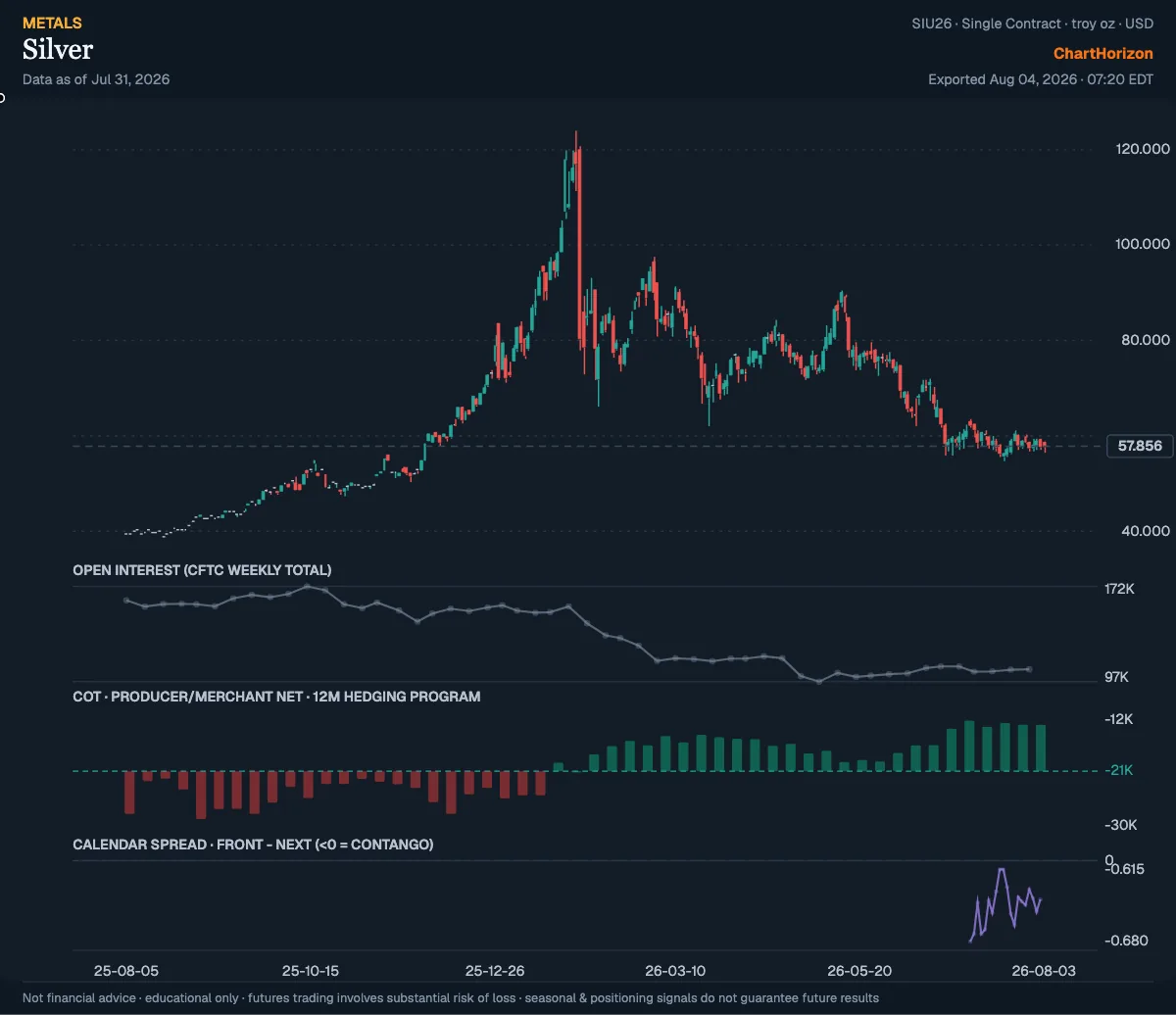
And if gold’s hedging book is quiet, silver’s is nearly silent. Silver made 121.30 on the same day gold made its high, and closed 31 July at 57.59 — it has more than halved in six months. The producer/merchant book stands at 13,029 net short, and 99.3 per cent of every report on the five-year file shows a bigger short than that. A halving of the price, and the people who dig it out of the ground have all but stopped selling it forward.
I do not know what the miners know. I know what they are declining to do, and they are declining to do it in two metals at once, at the same percentile, after the worst six months either has had in a decade.
The read
The vault story, as it is usually told, is wrong in its mechanism and roughly right in its direction, which is the most dangerous combination a market narrative can have — because it will appear to be confirmed by events it did not predict.
What is actually established, and what is not:
Established. The COMEX pile is genuinely smaller, and most of the shrinkage is a 2025 tariff-scare stockpile going home to London, which the LBMA’s own recovery to 9,372 tonnes corroborates. Asia is not bidding the metal away — the Shanghai premium has spent a month within a per cent of zero in both directions. Official institutions bought 289 tonnes in the second quarter, up sixty-two per cent, into a twenty-seven per cent drawdown, while ETFs redeemed and jewellery fell seventeen per cent. China has drafted a framework that moves cross-border gold from central-bank discretion to routine customs throughput. Producers in both metals are carrying among the lightest hedge books of the past five years.
Not established. That any of this makes gold go up next month. It does not. A metal can be structurally accumulated by patient sovereign hands and still fall for another two quarters on real yields, because the marginal price is set by the impatient. That is exactly what the past six months were. Monday’s session made the point: the tape opened at 4,135.20 on news that Washington had paused planned strikes on Iran after allies pressed for de-escalation — up 0.7 per cent — and then spent the day giving it back. Gold’s news is not currently gold’s price.
So the watch-list, which is the honest holding here rather than a position.
Watch the Shanghai premium, and watch it for a sustained break above one per cent — not a day, a fortnight. That is the number that would convert the eastward story from a change in ownership into an actual movement of bullion, and it is presently telling you it has not happened.
Watch the registered stock rather than the total. Eligible metal going home to London is housekeeping. Registered stock falling while delivery volumes stay elevated is a shrinking deliverable float against live obligations, and that is the version of the drain that has teeth.
Watch the calendar spread, because it is the cheapest tightness gauge available and it has been narrowing for three months into rising rates. Let it keep closing toward zero and the lease market is telling you something the warehouse report is too slow to say.
Watch the hedging book above all. Producers who will not sell a twenty-seven per cent decline forward have made a judgement. If they start selling into the next rally, they have changed their minds and you should change yours. If they hold this light through another leg down, that is a supply side that has stopped believing in the price on the screen.
And watch the Chinese draft become a rule. Consultation documents are not policy. But a state that widens its bullion plumbing at the exact moment its central bank is posting its largest reserve addition in three years is not doing two unrelated things.
The metal did not run east. It was bought east — slowly, at ordinary prices, by buyers who do not care what the ounce does next quarter, from sellers who cared a great deal. The vault reports record the freight. They do not record the transfer, and the transfer is the whole of it.
Informational and educational only — not financial advice. Futures trading involves substantial risk of loss; seasonal and positioning signals do not guarantee future results. Signals and charts: ChartHorizon (local end-of-day data).