Funded in Euros
Two weeks after the first joint US-Japan intervention since 2011, the dollar is back at 159.21 and the hedgers have sold 69 per cent of their yen long.
Prices through 17 August 2026 · COT through the 11 August report · a currency note · Data: ChartHorizon, CFTC & press reports · Charts: ChartHorizon
A fortnight ago this desk wrote that governments can buy a currency but have never yet bought a trend, and set out the handful of things that would tell us which of those two Tokyo had managed. The answers have come back faster than expected, and they are not the ones the defence was hoping for.
But the question that has arrived with them is the more interesting one, and it is the question a reader put to me this week: if the intervention does not hold, where does the carry trade go? Does the world start borrowing euros instead?
It is a good question with an uncomfortable answer. It has already happened. And it is not a consequence of the intervention failing — it is one of the reasons the intervention is failing.
Nine sessions, no news
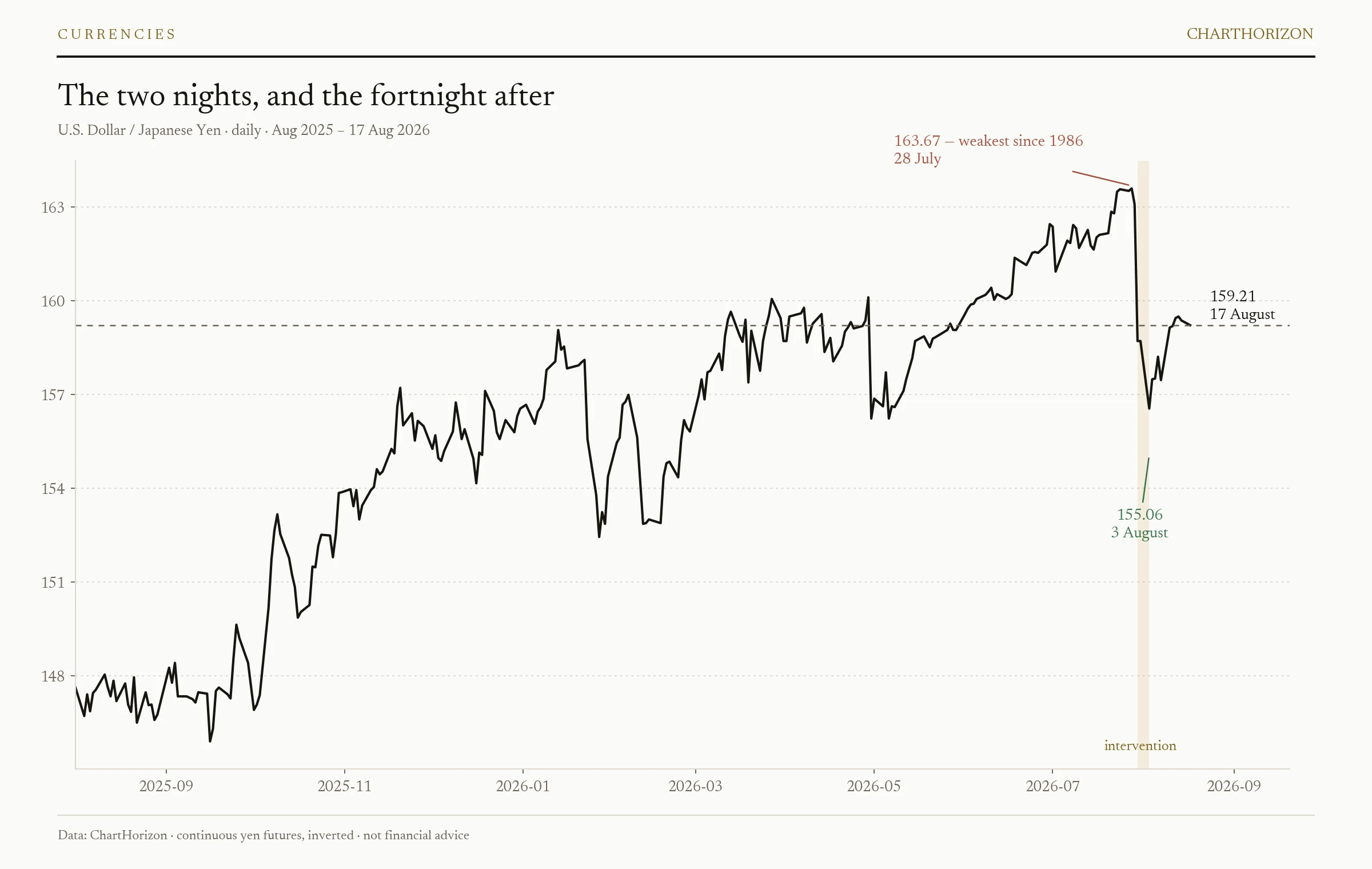
The best print the yen managed was not made during the operation. It was made on the Monday after it, 3 August, at 155.06 — some eight and a half yen from the 163.67 that marked the weakest the currency had been since 1986. Then it stopped, and what followed is the part worth studying.
| Session | Close | Session | Close |
|---|---|---|---|
| 3 Aug | 156.54 | 11 Aug | 159.18 |
| 4 Aug | 157.48 | 12 Aug | 159.44 |
| 5 Aug | 157.51 | 13 Aug | 159.49 |
| 6 Aug | 158.20 | 14 Aug | 159.36 |
| 7 Aug | 157.46 | 17 Aug | 159.21 |
| 10 Aug | 159.13 |
Not one session in that column is violent. There was no headline, no data shock, no second government. It is the staircase again — three steps up, one small step back, no step back quite undoing the three — the same gait the market used for the twelve months before the Ministry of Finance ever picked up the telephone. Whatever else it means, a market that resumes its old walk nine sessions after the largest single day of yen buying in history is a market that has decided the interruption was an interruption.
Half of what was taken has been handed back. And it has been handed back on an absence: there has been no second operation. Japan is estimated to have sold something close to $59bn across the two nights and Washington another five to ten, on top of the ¥11.7 trillion spent in the spring and the $20.7bn in July. Silence since. In this market, a defence that does not repeat is read as a ceiling test that the seller passed.
To be fair to the defence, one thing it has achieved: the dollar has not reclaimed 160. The highest tick in the whole recovery is 159.52. That was the first of the conditions this desk set out a fortnight ago, and on that narrow measure the reversal is still alive. It is the only one of them still standing.
They did not hold it
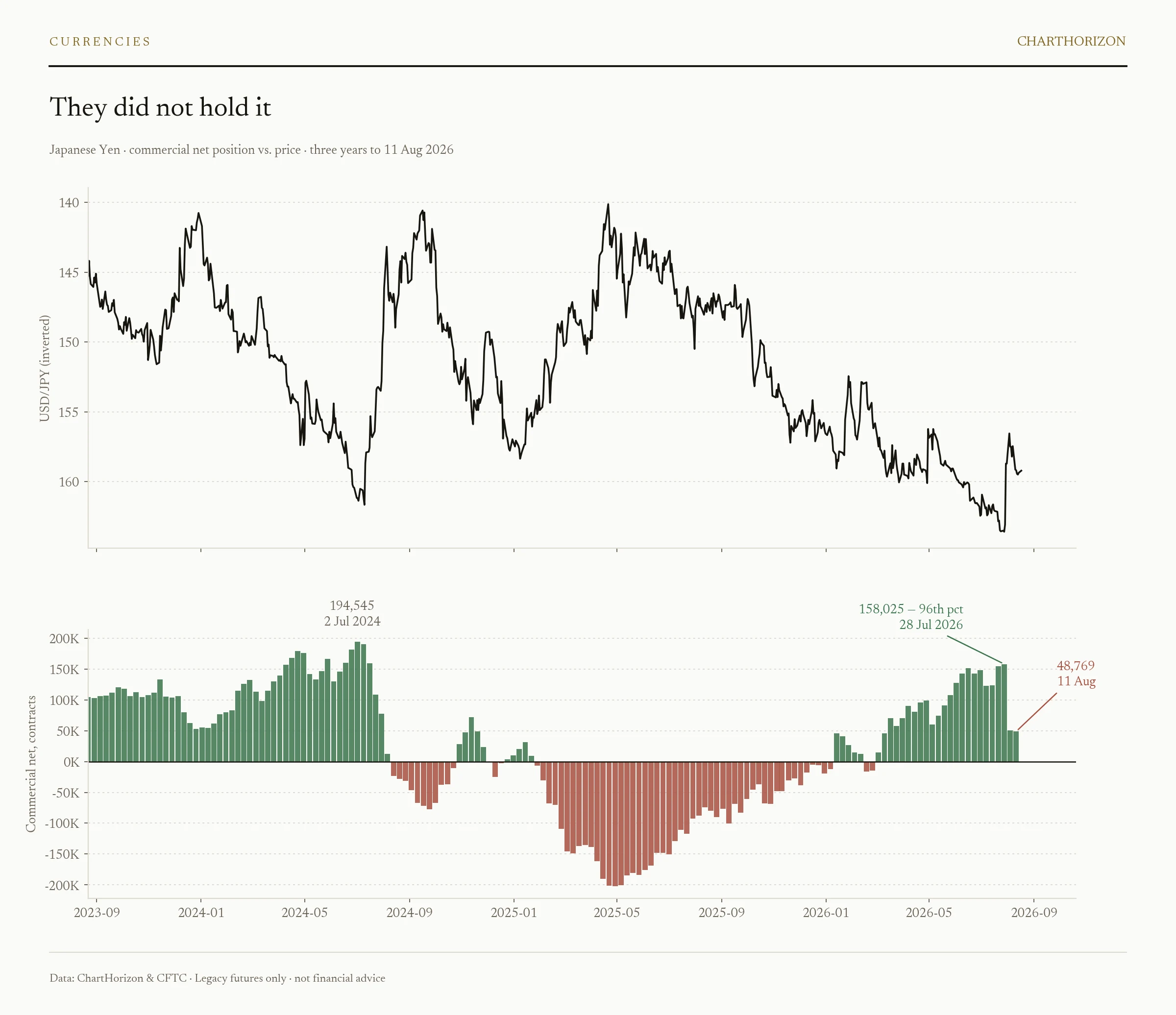
Here is the condition that mattered most, and it has failed outright.
The case for taking this intervention more seriously than the three before it rested on a single fact: the commercial hedgers were already long the yen with both hands before a single yen was bought — 158,025 contracts on the report of 28 July, the 96th percentile of every weekly report since the record begins in June 2021. Intervention fired into a crowded, profitable, one-sided short is how a squeeze starts. That was the whole argument.
What this desk asked of the next two reports was that the hedgers hold that position rather than quietly sell it into the government’s bid. They did not hold it.
| CFTC report | Commercial net long | Open interest |
|---|---|---|
| 21 Jul 2026 | 154,898 | 423,796 |
| 28 Jul 2026 | 158,025 | 432,366 |
| 4 Aug 2026 | 50,568 | 419,393 |
| 11 Aug 2026 | 48,769 | 391,874 |
One hundred and nine thousand contracts, sixty-nine per cent of the book, gone in a fortnight — and gone into falling open interest, which is the detail that separates a position being closed from a position being transferred. A book at the 96th percentile of five years now sits at the 35th. The people who were positioned before the news existed took the money the government put on the table and walked away from the table.
I want to be careful about what that does and does not prove. It does not make them right; the commercials are not prophets, and the same file shows them wrong for months at a stretch. What it removes is the mechanism. A squeeze needs a crowd that must buy, and the arithmetic of the COT is that the hedgers’ long is the mirror of everybody else’s short. Cutting 109,000 contracts of commercial long means roughly 109,000 contracts of speculative short were bought back in two weeks — the squeeze happened, it was real, it was one of the largest on the file, and the dollar is at 159 anyway.
The 2024 sequence sits in the same panel for comparison, and the shape is the thing. The commercial long peaked at 194,545 on 2 July 2024, was down to 12,196 by 6 August and outright net short a week after that. The difference is what the selling was sold into. In 2024 the hedgers distributed into a genuine rout — the Bank of Japan had raised rates on 31 July, a soft payroll print followed, and the dollar was at 143 within five weeks. They were paid the whole way down. This time they have distributed into a two-day bounce that has already given back half its ground. Same behaviour, and so far a much worse tape to have done it into.
The trade changed its funding, not its mind
Now to the reader’s question, which the paragraph above has already half-answered.
An intervention does not make the carry trade unattractive. It cannot: it does nothing whatever to the interest differential that is the trade’s entire reason for existing. What it does is make one particular funding leg dangerous — because a currency you are short can now take six yen off you in an hour on a decision made in a room you cannot see into.
Faced with that, the market did the obvious thing. It kept the trade and changed the borrowing.
The rotation is not a forecast; it is reported fact and it predates the defence. Morgan Stanley told clients this month that the threat of further intervention supports a shift towards the euro and the Swiss franc as the funders of choice. The version of the trade most in favour this year — borrowing euros to buy a basket of Brazilian real, Colombian peso and Turkish lira — is up roughly 19 per cent in 2026, its best year since 2005. Citigroup’s read is that this diversification is precisely what has made the whole complex less fragile than it was before 2024, when, as their strategist put it, everything was funded out of yen. Bloomberg’s emerging-market carry index fell one per cent after this intervention. In August 2024 it fell four.
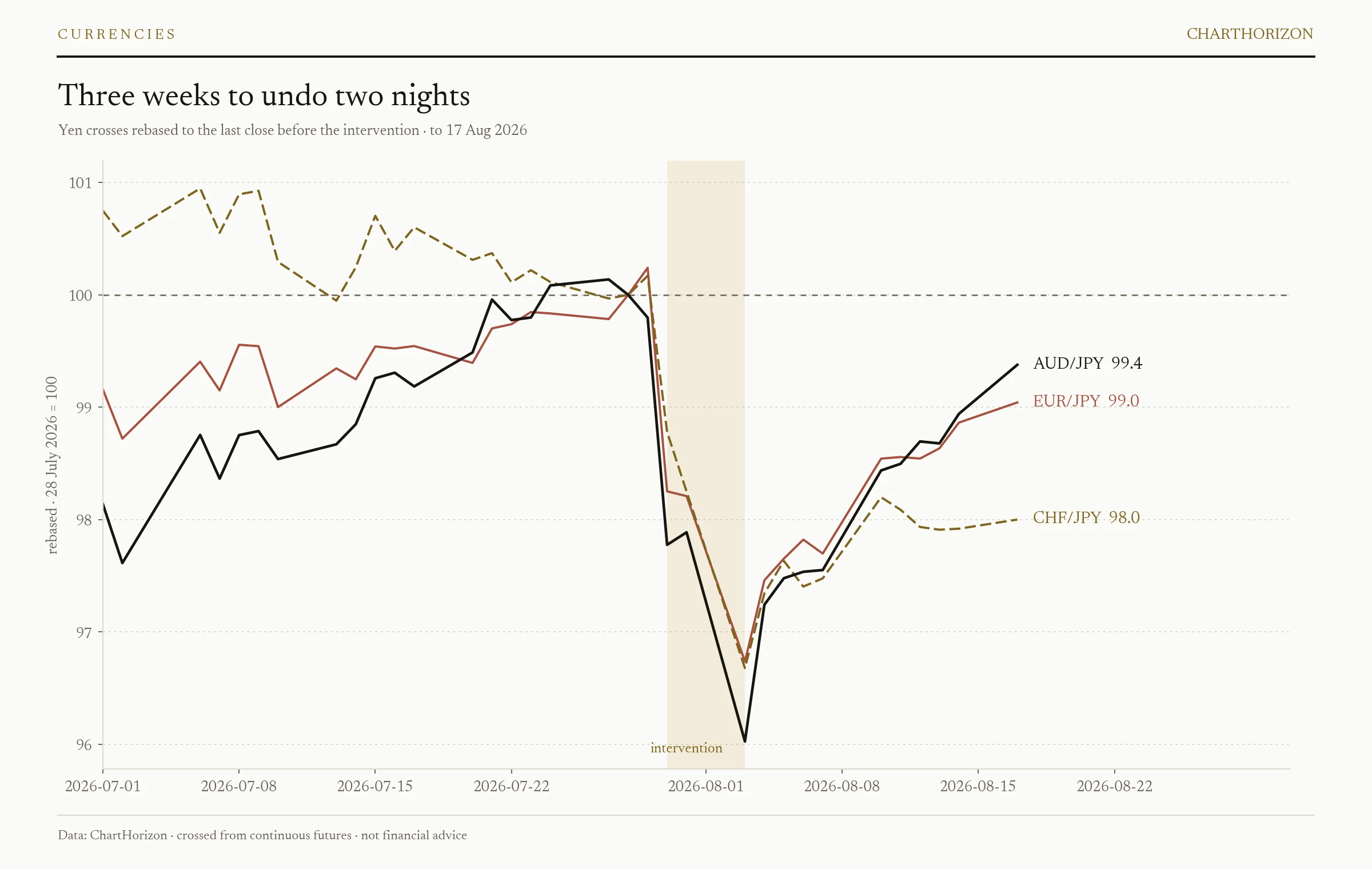
Our own crosses tell the same story from the price side, and they are worth being precise about, because they are crossed from this desk’s continuous futures and run a shade away from the spot fixings quoted here a fortnight ago. Rebased to the last close before the operation, AUD/JPY lost four per cent and has taken back three and a half of it; EUR/JPY and CHF/JPY did the same thing in the same shape. The most comfortable trade in currencies dipped, held, and resumed.
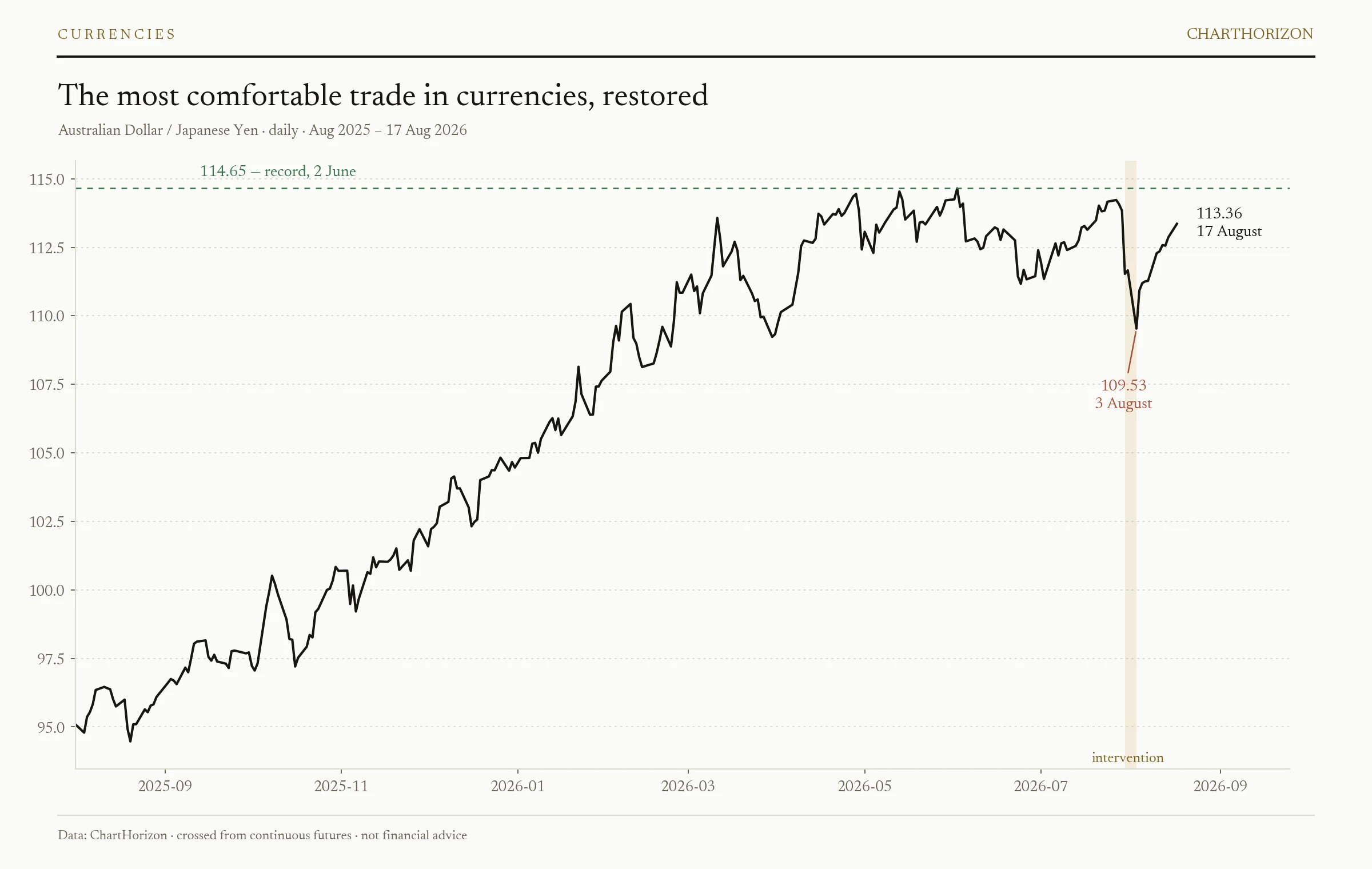
A fortnight ago the second condition on the watch-list was AUD/JPY losing the shelf around 110, because that is where a carry crowd stops defending and starts liquidating. It lost it — 109.53 on 3 August — and had it back inside a session. A level that breaks and is immediately reclaimed has not warned the bulls; it has cleared out the people who were short of them. At 113.36 the cross is 1.3 yen from its June record, three weeks after the largest yen-buying operation ever mounted.
And ChartHorizon’s own strength board, dated 17 August, has moved against the yen rather than with it. On 1 August the board scored the yen at −0.1 and AUD/JPY at Bull +4.1 of 12. Today the yen is the weakest currency on the board at −2.1 and AUD/JPY is the most bullish pair on it at +7.1. Two weeks of official defence, and the board reads the yen as weaker than it did the morning after the money was spent.
Sold in euros, borrowed in euros
There is a detail in the operation itself that has not had the attention it deserves, and it is the neatest illustration of the whole problem.
When the Federal Reserve Bank of New York bought yen for the Treasury on 31 July, it did not sell dollars to do it. It sold euros — reportedly through Goldman Sachs and Morgan Stanley — to avoid disturbing its own Treasury market.
So the United States raised the money for its first yen intervention in fifteen years by supplying the market with the very currency the street is now borrowing to short the yen with. That is not incompetence; given the constraint it was the sensible instrument. It is simply a very clean picture of a defence that operated on the yen leg of the trade while leaving the other leg not merely intact but better supplied.
The euro’s institutional direction points the same way. From this quarter the ECB has converted its euro repo lines from a discretionary emergency tool into a standing facility open in principle to any central bank in the world. That policy is aimed at the euro’s reserve role, not at carry traders, and it would be wrong to conflate the two. But the plumbing that makes a currency easy for the world’s institutions to obtain is the same plumbing that makes it easy to borrow, and it is being deliberately widened.
What a 2.25 per cent funding leg is telling you
Here is where I would slow down, because the euro-funded trade is being written up as the safe version and it is not obviously that.
Consider what it costs. The ECB’s deposit rate is 2.25 per cent — and it got there by raising in June, not cutting, as the energy shock from the Iran war worked through euro-area prices. The Bank of Japan’s overnight call rate is 1.00. The Swiss National Bank’s policy rate is zero, where twenty-eight of twenty-nine economists polled expect it to stay all year.
| Policy rate | Direction | |
|---|---|---|
| Swiss National Bank | 0.00% | on hold all year |
| Bank of Japan | 1.00% | hiking, September ~80% priced |
| European Central Bank | 2.25% | raised in June |
| Federal Reserve | 3.50–3.75% | — |
| Reserve Bank of Australia | 4.35% | — |
By any historical standard the euro is an expensive thing to be short of. A funding currency is supposed to be cheap and, ideally, falling; the euro is neither. It has been strong enough this year that members of the Governing Council have begun warning publicly that further appreciation could force them to start cutting again.
So ask what the 19 per cent is actually made of. It cannot be the interest differential: borrowing at 2.25 to lend in Brazil does not produce nineteen points in eight months. The bulk of that return is emerging-market currency appreciation, some of it leveraged. That is a directional bet on the real, the peso and the lira wearing a carry trade’s clothes — and the distinction matters, because a carry trade funded at 0.5 per cent can sit through a bad quarter on its coupon while one funded at 2.25 is bleeding from the moment the spot move stops going its way.
The comfort being taken from diversified funding is real, and Citigroup is right that a complex funded four ways is sturdier than one funded entirely out of Tokyo. But it is worth naming the other half of that: diversification has not reduced the position, only distributed it. The same crowd is in the same destination trades. It has three landlords now instead of one.
The read
The intervention has not been defeated. It has been absorbed, which is a slower and less dramatic thing and, for anyone holding a yen long, a worse one. The 163.67 high still stands unchallenged and 160 has not been reclaimed; on the tape, the reversal of 30 July is technically still intact. In the ledger, it is finished. The book that made this defence more interesting than the last three has been three-quarters dismantled by the people who built it, and no amount of chart reading recovers a position that has been sold.
And the answer to the question this piece began with is that the euro carry trade does not need the yen to fail, because it is already here and already paying. What the intervention accomplished was to make the yen leg of a very large trade unattractive without making the trade unattractive. The money did not go home. It refinanced.
Which leaves the same conclusion the last note reached, arrived at from the opposite direction: watch the Bank, not the Ministry. The Ministry of Finance can only ever make the yen expensive to borrow for an evening. The Bank of Japan can make it expensive to borrow permanently, and that is the only thing that has ever ended one of these trades. In 2024 the rout required a rate rise, not a defence. The market now prices something near an eighty per cent chance of a September hike, the July summary of opinions flagged upside price risks and a possibly faster pace, and analysts are beginning to talk about a December follow-up — a quarterly rhythm rather than an annual gesture. That, and not the size of the next operation, is the number to hold in your head.
Two things would tell you it has begun. The first is the differential doing the work the intervention could not: each 25 basis points from Tokyo takes the euro-yen funding gap from 125 towards nothing, and the day the cheapest money in the developed world is unambiguously Swiss rather than Japanese is the day the yen stops being the instrument of this trade for structural rather than tactical reasons. The second is the hedgers rebuilding — a commercial book that starts climbing again from the 35th percentile, while price is still weak, would say the same people who just sold are willing to pay to be long again at a worse level.
Neither has happened. Until one does, the honest position is the one the tape is already expressing: the trend is intact, the defence is spent, the trade has refinanced, and the only institution that can change any of that meets in September. There is no prize for anticipating a central bank, and no penalty at all for reading it afterwards.
Informational and educational only — not financial advice. Futures trading involves substantial risk of loss; seasonal and positioning signals do not guarantee future results. Signals and charts: ChartHorizon (local end-of-day data).