The Wrong End of the Curve
Since 1 July the two-year future has lost 0.19 per cent and the thirty-year 2.88 — damage that scales with duration, not with the funds rate.
Prices through 27 August 2026 · COT through the 18 August report · a rates note · Data: ChartHorizon, CFTC, U.S. Treasury & press reports · Charts: ChartHorizon
Kevin Warsh speaks at Jackson Hole this morning, ten o’clock Mountain time, in his first keynote as chairman. Bank of America’s fund manager survey has sixty-nine per cent of respondents expecting a neutral tone. Every clause will be read for what it implies about September and the federal funds rate.
There is a difficulty with reading it that way. The federal funds rate is not where this summer’s damage was done, and the instrument Warsh controls does not reach the part of the market that came apart.
Eight weeks, four maturities
Take the Treasury complex since 1 July. The two-year note future is down 0.19 per cent. The five-year is down 0.65. The ten-year, 1.17. The thirty-year, 2.88.
That is not a bond market selling off. It is a bond market selling off in near-exact proportion to how long you are asked to hold the paper — fifteen times the damage at thirty years as at two. The two-year is the contract that trades the Fed, and the two-year is essentially where it started the summer.
This desk set out that diagnosis on 20 August and nothing since has disturbed it: only the long end is broken, and what is failing there is the market’s willingness to warehouse duration at any price, which is a question about the supply of long bonds and the shrinking population of people who will hold them. It is not a question about the overnight rate.
The one intervention aimed at the right place
On 19 August the Treasury said it would at least double its liquidity-support buybacks of long-dated coupons, from $2bn to at least $4bn an operation, in the ten-to-twenty and twenty-to-thirty-year sectors. Nothing shorter. Whoever drafted it had read the same chart.
The answer was immediate. The thirty-year future put in 1.31 points, its largest day of 2026, on 1,095,383 contracts — 2.3 times the average of the twenty sessions before it. The yield fell nine basis points to 5.196 per cent, down from a level that had been the highest since 2007.
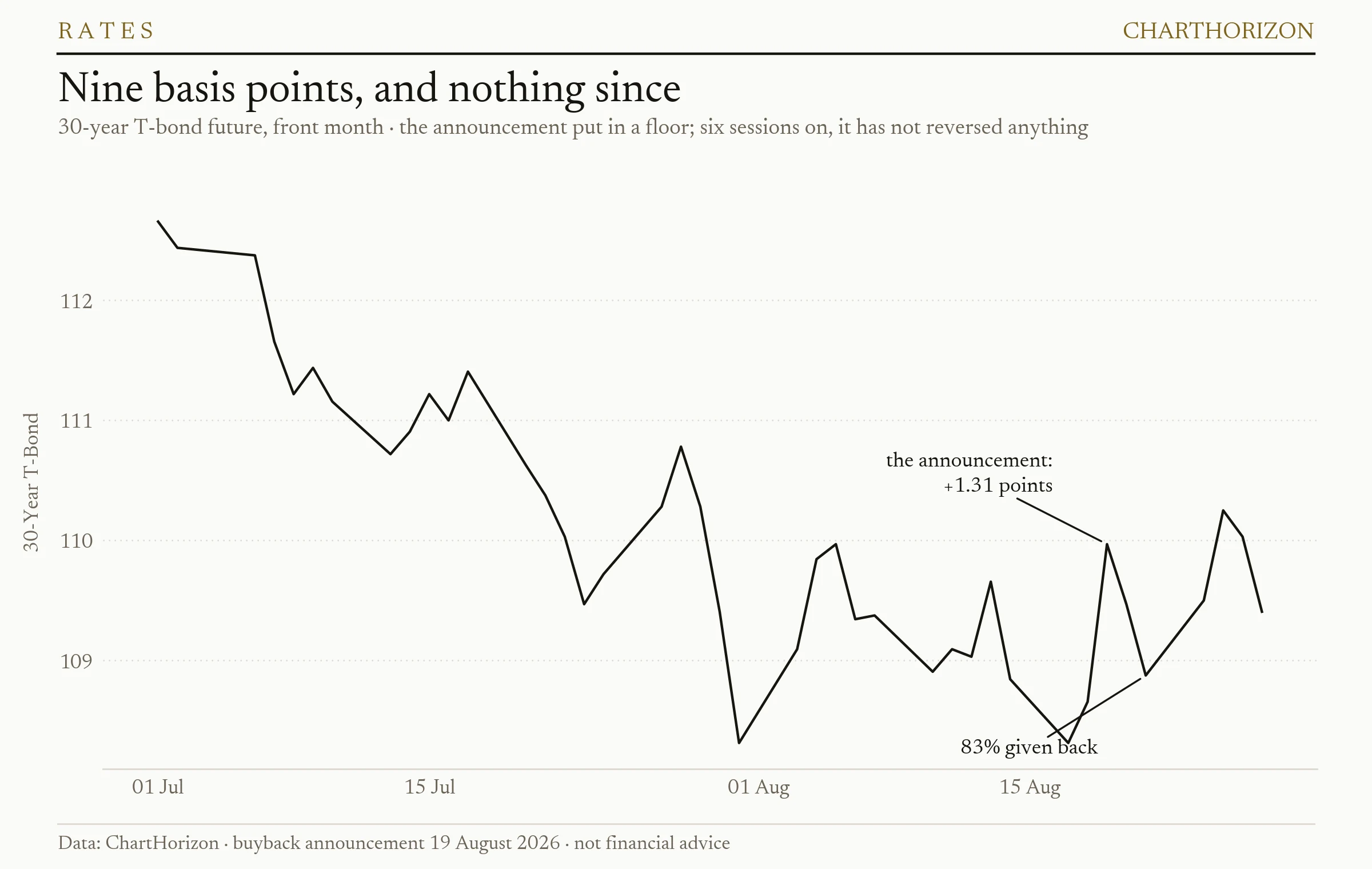
Then it stopped. Eighty-three per cent of that day was handed back within two sessions. A second attempt carried to 110.25 on 25 August, the best close since 29 July, and that went as well. On Thursday the thirty-year yield closed at 5.19 per cent.
Be precise about what that means, because the easy version overstates it. The announcement did buy something — about nine basis points — and those nine basis points have held. What it has not bought, in the six sessions since, is a single further one. The Treasury put a floor under the price. The floor sits at a yield that is still the highest in nineteen years.
The operation itself has not begun. The larger sizes take effect on 9 September and run to 4 November, so what has been tested so far is only the announcement — the part meant to work through expectations, which is the cheap part. On this desk’s arithmetic of 20 August, the whole programme comes to roughly 0.14 per cent of the paper it is meant to support. It was never going to be bought outright. It was meant to be believed.
The dollar votes on what kind of problem this is
There is a straightforward test for whether rising long yields are a tightening or a premium, and it does not require an opinion. If money is getting dearer, the currency should rise with the yield. Capital goes where it is paid.
Over the same eight weeks the dollar index fell 2.22 per cent. Gold rose 14.42 per cent. Silver rose 16.61.
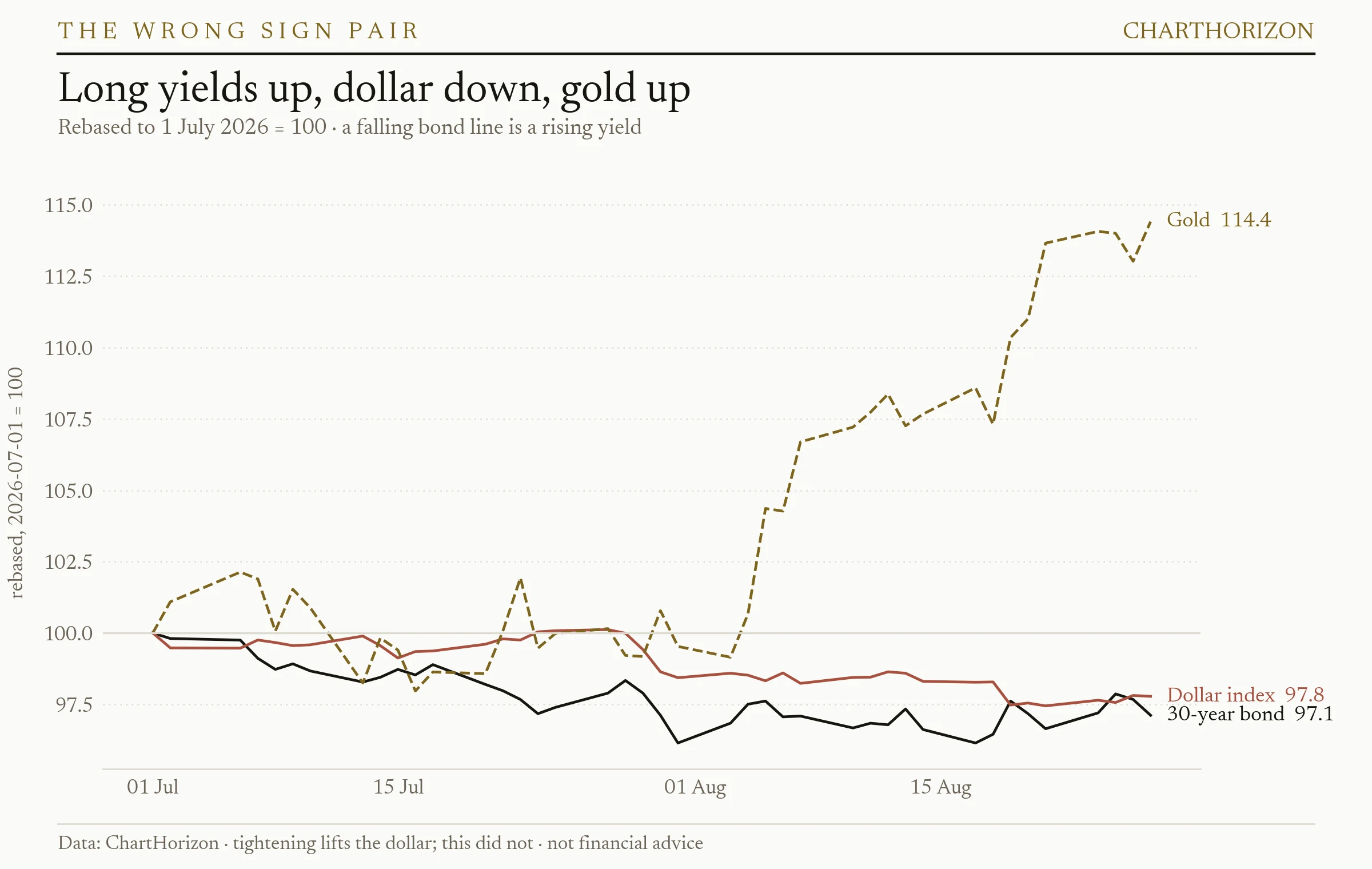
Long yields up, currency down, metals up is the wrong sign pair for tightening. It is the signature of a premium being demanded — investors asking to be paid more to hold the paper and the currency both, which is a statement about the issuer rather than about the price of money.
Two qualifications, because the chart flatters the argument. Gold is not setting records: it remains 12.5 per cent below its 29 January peak, and this run is a recovery off a 16 July low rather than a mania — silver is still 39 per cent below its own January high. And the move was not a broad commodity bid. In the first week of August, when gold rose 7.6 per cent and silver 9.8, copper managed 0.9. This is a signal in the two metals that trade as money, which is the narrower and more pointed version of the claim, not the loud one.
Who is on the other side
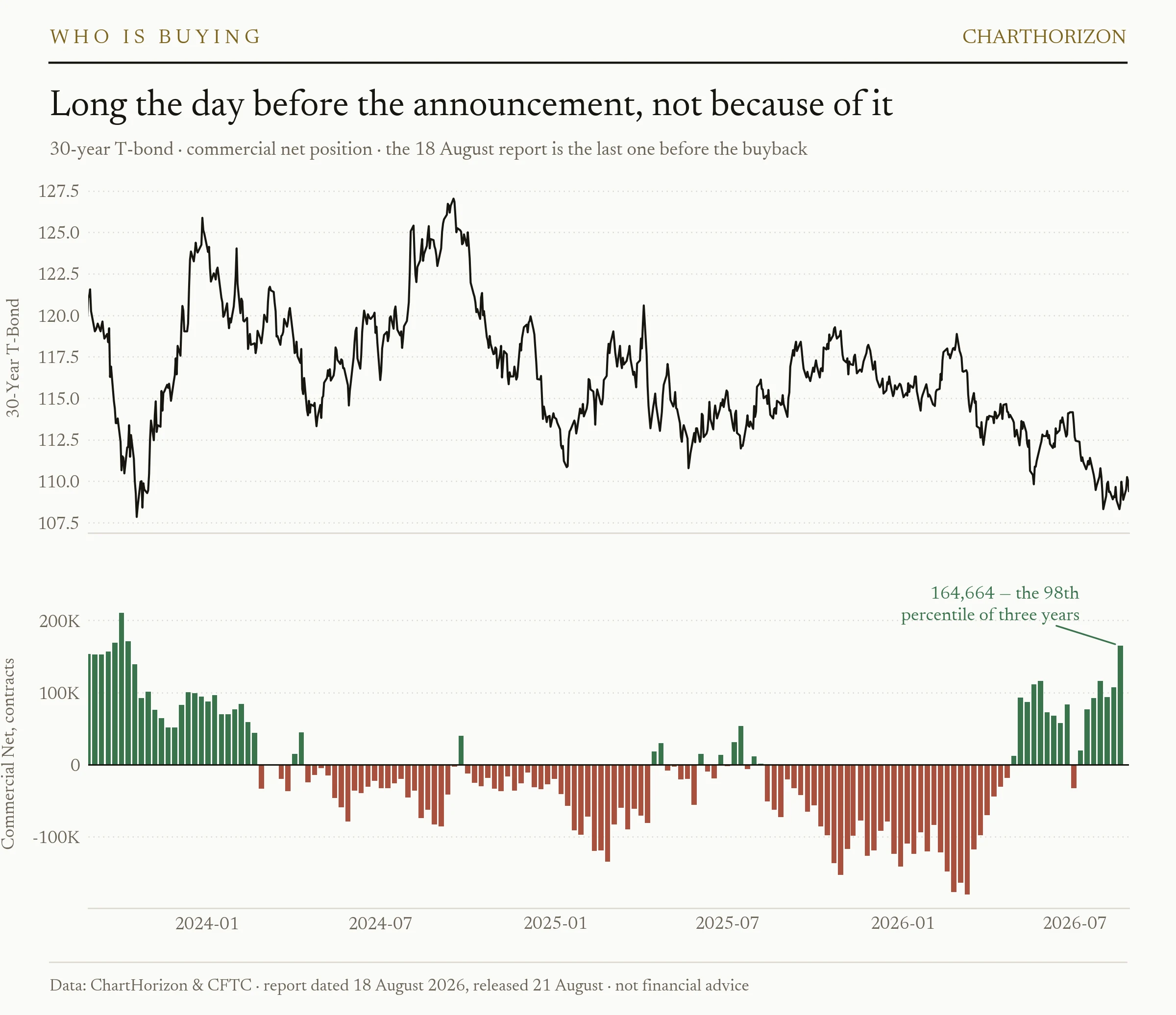
This desk’s COT archive has the commercial book in the thirty-year at 93,846 net long in the report dated 4 August, 107,107 on the 11th, and 164,664 on the 18th. Fifty-seven thousand contracts added in one week, into the highest yields since 2007, taking the hedgers to the 98th percentile of three years. The same book was 179,711 net short in the report dated 10 March, a three-year low; it flipped long in late April and has stayed long since, bar a single week at the end of June.
Read the date carefully, because it is the whole point. The 18 August report is a snapshot of that Tuesday. It was published on the 21st, but the positions predate the announcement by a day. The hedgers did not follow the Treasury into the trade. They were already there, which is the same thing this desk found eight days early last week and is now finding a week earlier still.
What they did after the announcement failed to extend is not yet known. That report — dated 25 August — is released this afternoon at half past three in New York. Five and a half hours after the speech.
The symposium is not about this
One fact goes almost unmentioned in the previews. The official theme of this year’s symposium is Financial Innovation: Implications for Payments and Policy. Not the policy path, not the long end: payments, before an audience of roughly 120 officials from more than seventy countries.
A chairman is under no obligation to discuss the funds rate at all, and a first keynote is a strange place to start. The backdrop, for what it is worth: the target range is 3.50–3.75 per cent with the effective rate at 3.63, inflation is running near 4.2 per cent, and the July meeting moved the committee’s median end-2026 rate to 3.8 from 3.4, with nine of eighteen participants marking a hike this year. September still favours a hold, with hike odds near one in three.
So the front end has very little priced, which is why yesterday’s note observed that a surprise has more room to travel up than down. That remains true. It is also beside today’s point — because whichever way the front end moves this afternoon, that is the two-year’s business, and the two-year is not what has been failing since July.
What would settle it
Nothing said at ten o’clock Mountain time is a bid for thirty-year paper. Three things are, and none of them is a speech:
The commitments report this afternoon, which shows whether the hedgers held a 98th-percentile long through the week the intervention stalled, or used the strength to leave. The first enlarged operation on 9 September, which is where the programme stops being an announcement and starts being a buyer. And the meeting of 15–16 September, which sets the rate that the two-year has already told us is not the problem.
The long end is priced by people who must hold duration and are asking to be paid more for it. That question is answered by supply, by the deficit, and by who is left at the end of the chain — not from a podium in Wyoming, however carefully the sentences are built.
Informational and educational only — not financial advice. Futures trading involves substantial risk of loss; seasonal and positioning signals do not guarantee future results. Signals and charts: ChartHorizon (local end-of-day data).