The Warning Was Filed on Tuesday
The week payrolls fell 23,000, the commercial book was already record long the T-Note and record short the dollar — filed three days before the number.
COT through the 4 August report · prices through 7 August 2026 · a positioning note · Data: ChartHorizon & CFTC
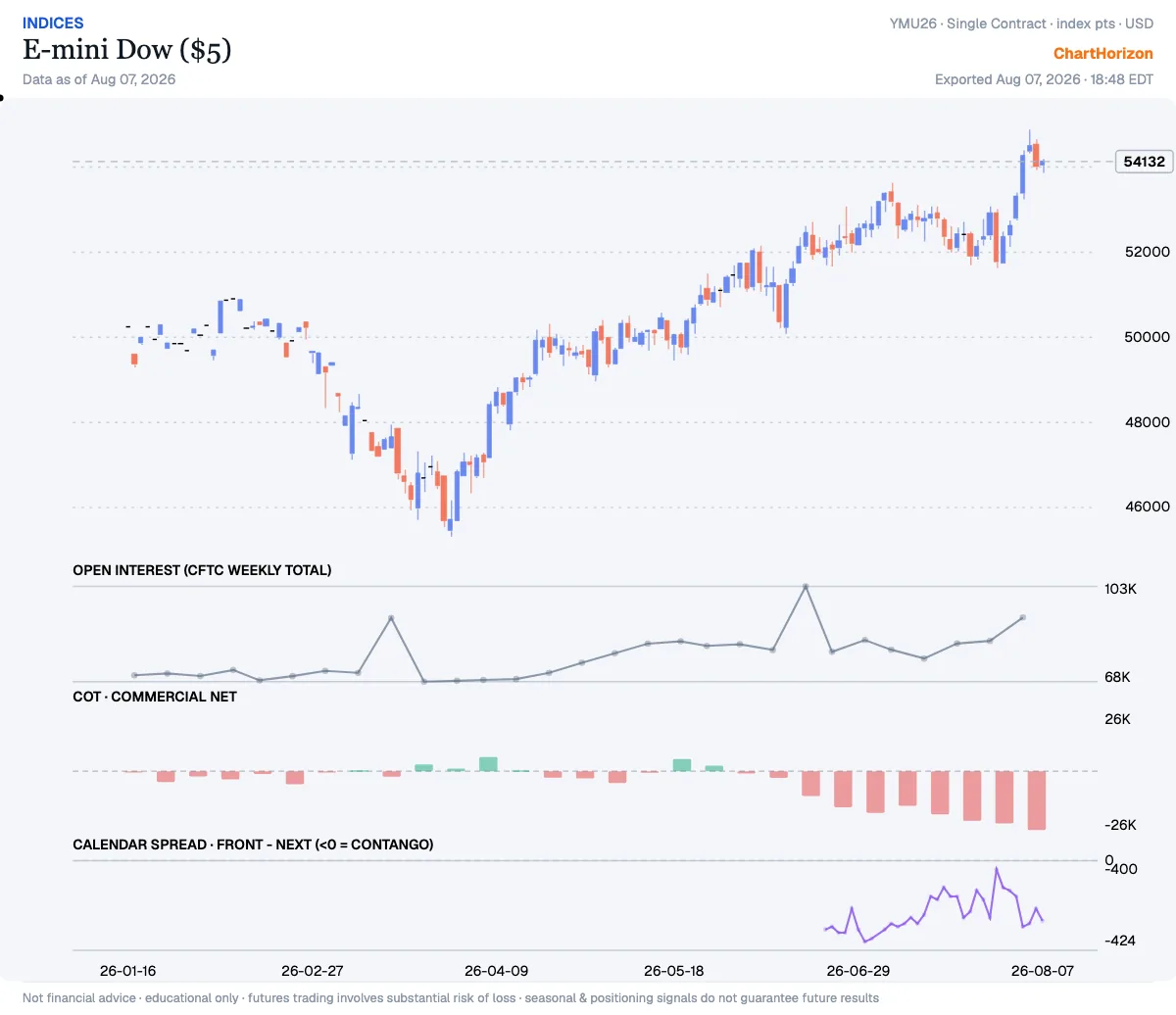
On Monday the Dow Jones Industrial Average closed at 53,178.41, up 693 points, an all-time high. On Tuesday the commercial hedgers in that contract were carrying their largest net short position in three years. On Friday the Bureau of Labor Statistics reported that American payrolls had fallen by 23,000 in July, against a consensus looking for a gain of eighty thousand.
Note the order of those three sentences. It is the only thing about this week worth thinking hard about.
The Commitments of Traders report published on Friday carries a snapshot dated Tuesday, 4 August. Whatever the hedgers knew or guessed, they had arranged their books before the payroll number existed — one day after the equity market printed its record, three days before the labour market printed its contraction. This is what makes the report worth reading at all. It is not a forecast. It is a record of what the people who must be in these markets were willing to pay to be protected from, at a moment when the tape was giving them every excuse not to bother.
Four entries in one hand
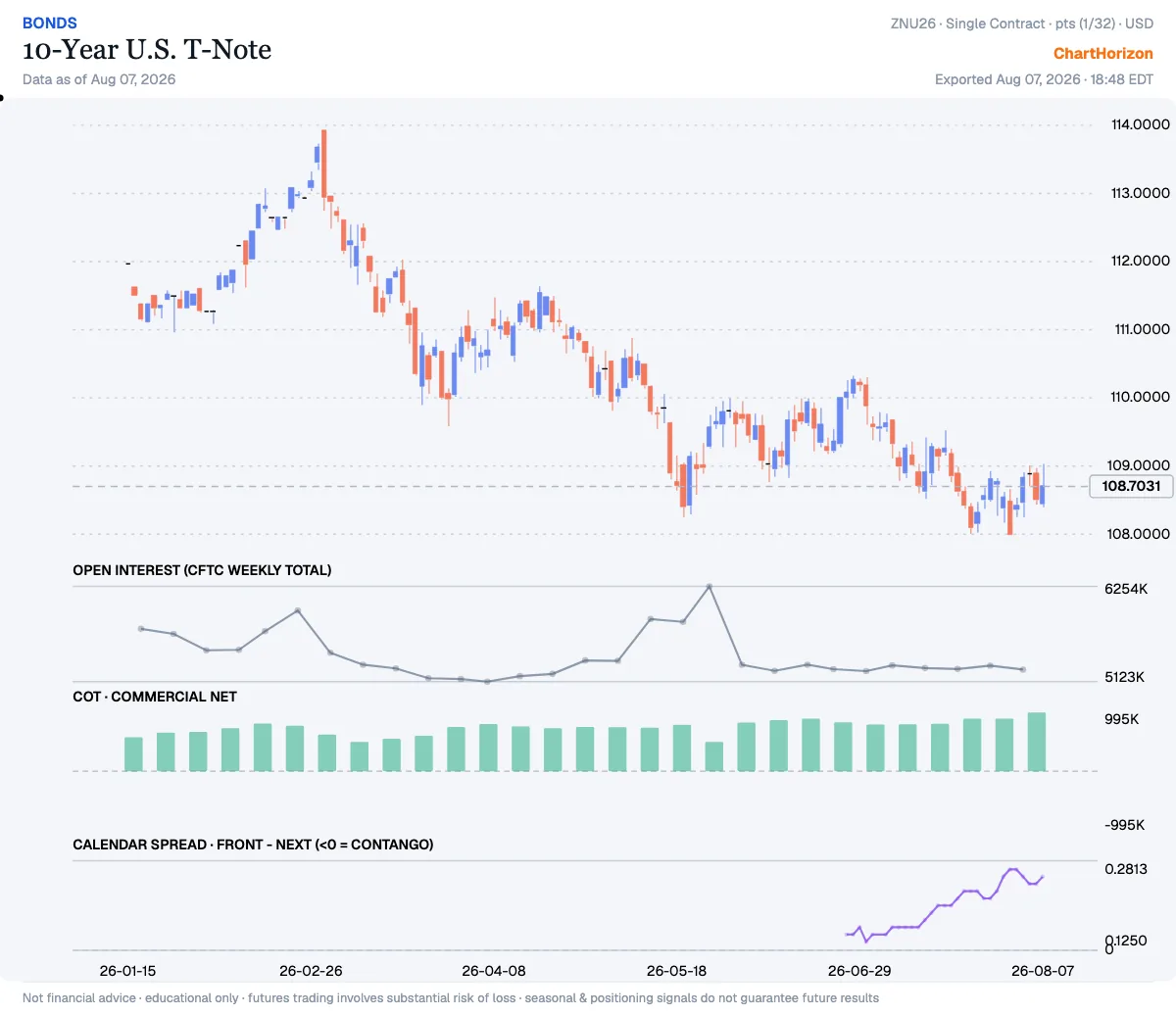
Commercial Net in the 10-Year T-Note stands at +995,416 contracts — the 100th percentile of its three-year range, and a fresh record for that window. In the Dollar Index the same cohort is net short 24,626 contracts, the 1st percentile, also a record. In the E-mini Dow they are short 25,579, the 1st percentile. And in Silver the producer book, which is structurally short because producers sell what they dig, has covered back to the least-short reading in three years.
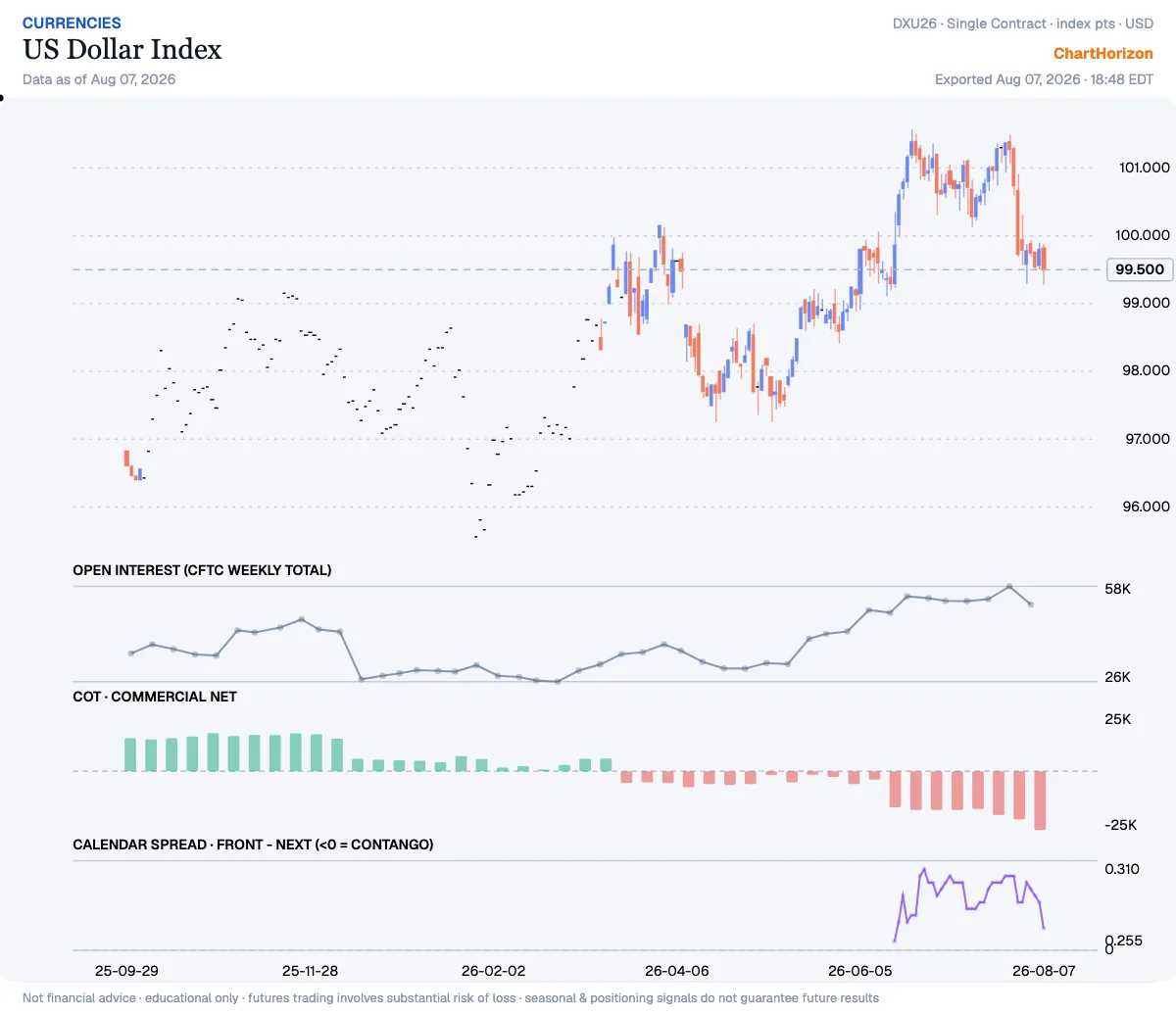
Read those four as one sentence and they say something quite specific: lower yields, a weaker dollar, equity downside worth paying for, and metal worth owning rather than hedging. That is not a diversified book. That is one opinion, expressed four times, by people who are not paid to have opinions.
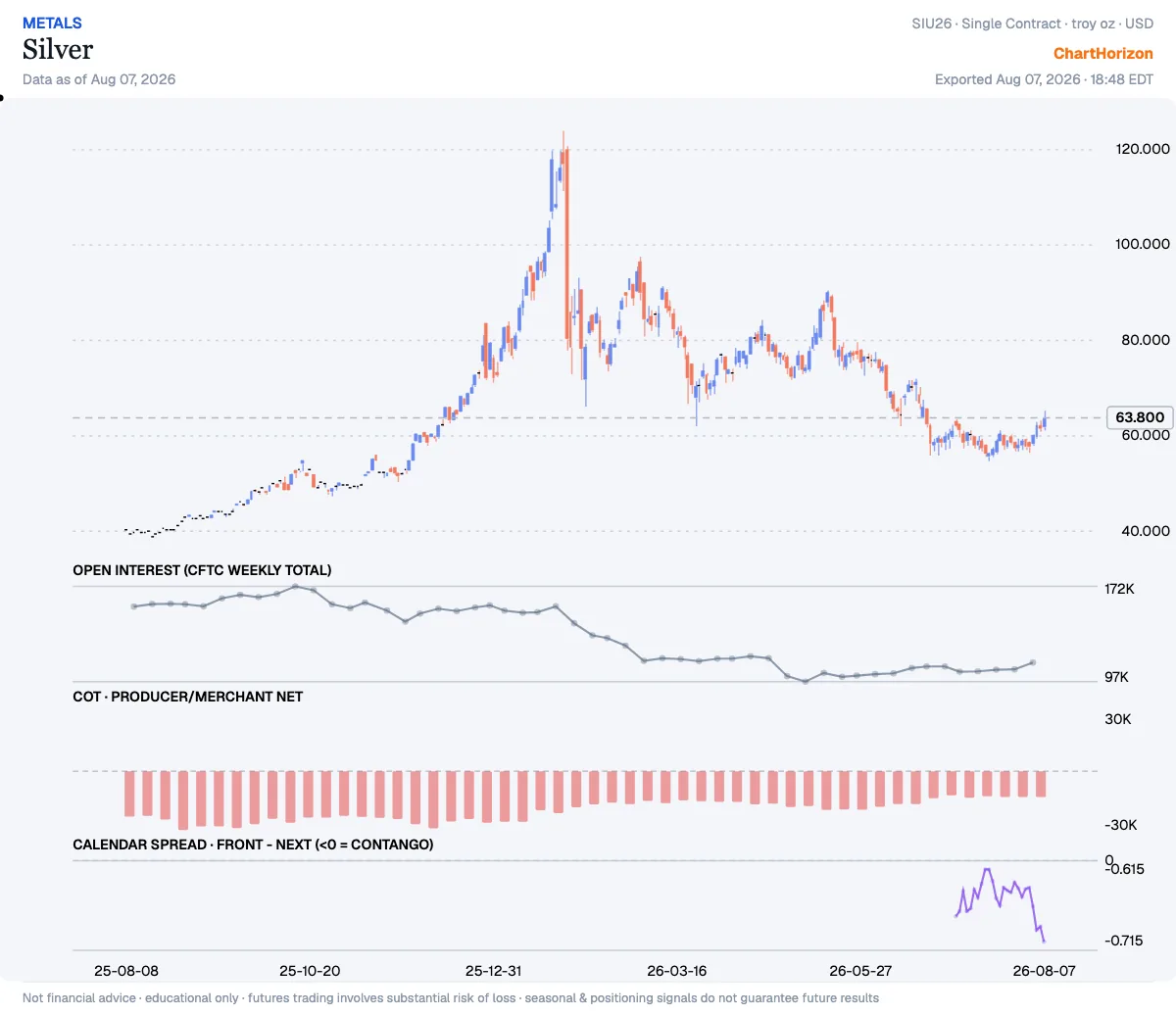
Silver deserves its own line, because the wording matters. The producer book is still net short 13,080 contracts. It has not turned long and it is not about to; a miner with metal in the ground sells it forward as a matter of arithmetic, not conviction. What has happened is that the miners have bought back more of that hedge than at any time in three years — while the metal ran better than nine per cent in a week to the neighbourhood of sixty-three dollars. Producers who lift hedges into strength are not calling a top. They are declining to sell the future cheaply, and that is a different animal.
What the week actually delivered
The hedgers filed on Tuesday. Here is what arrived afterwards.
Friday’s employment report was bad in the way that matters and ambiguous in the way that always follows. Payrolls fell 23,000. June was revised down to a gain of 20,000, and May and June together were marked down by 103,000 — a third of a year of job growth erased by revision. The unemployment rate fell, to 4.1 per cent, but it fell because people left the labour force rather than because they found work. And the headline was flattered in the other direction too: government payrolls dropped 53,000 on seasonal quirks that may be revised away, while private payrolls actually rose 30,000. It was a weak number with an argument inside it.
That argument runs directly into the Federal Reserve. On 29 July the Committee held the funds rate at 3.50–3.75 per cent for the fifth consecutive meeting — but the vote was 9–3, and all three dissenters wanted to raise. Beth Hammack, Neel Kashkari and Lorie Logan each preferred a quarter point higher. Three dissents pointing the same way had not happened since September 2016. The Committee’s own year-end projections had drifted up to a 3.6–4.1 per cent range, from 3.25–3.75 per cent previously. This is a Fed being pulled toward tightening by inflation while the labour market quietly contracts underneath it — and it is Kevin Warsh’s Fed now, sworn in on 22 May after the most divided confirmation vote in the institution’s history, and not a man the market reads as eager to cut.
So the commercial book is positioned for the labour market to win that argument. The Committee’s published projections say the other side wins. Both cannot be right, and only one of them is risking money on it.
Where the signal argues with itself
An honest ledger includes the entries that spoil the story, and there are two.
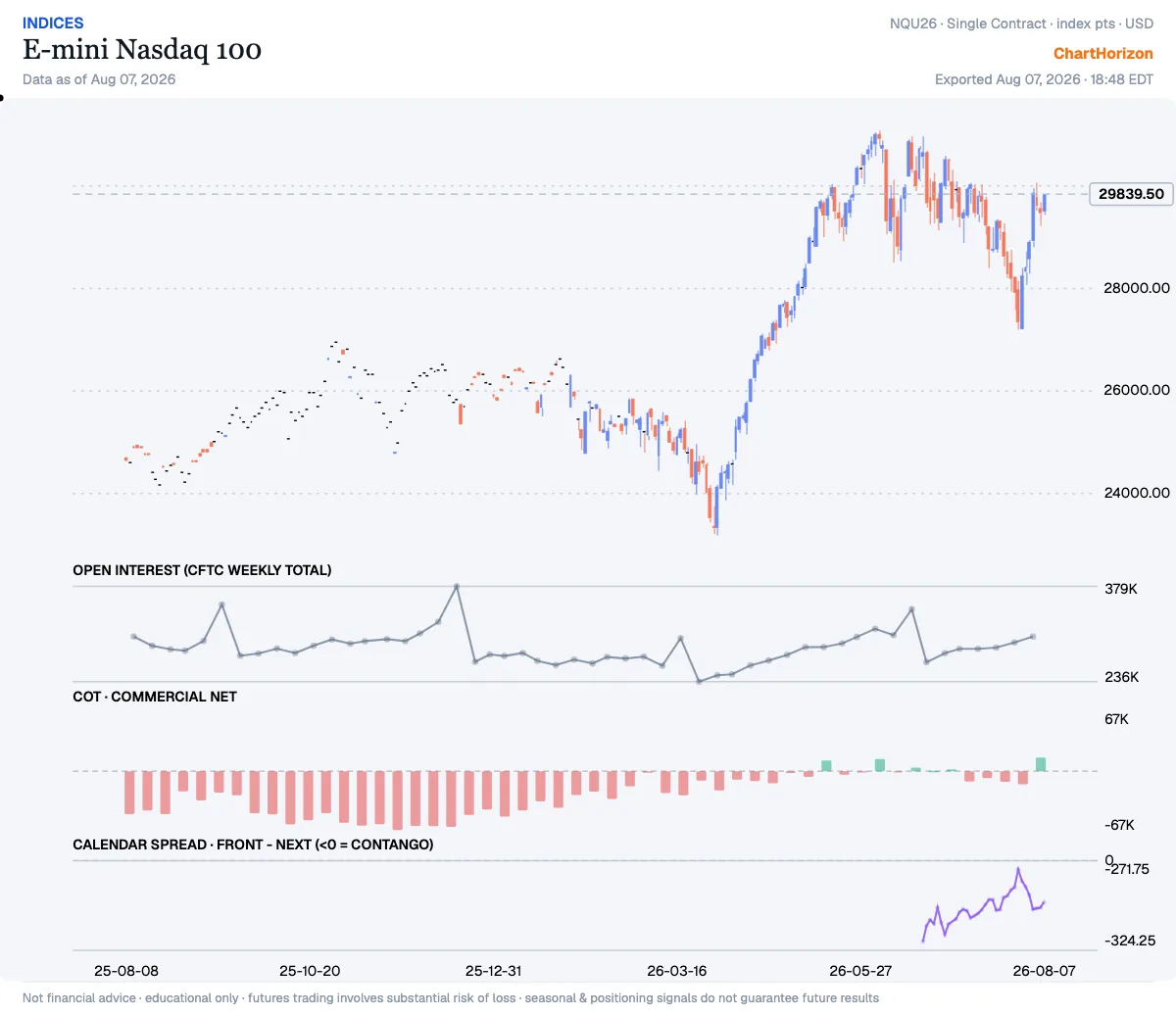
The first is the Nasdaq. In the same report, in the same week, commercials are at a record net long +15,442 contracts in the E-mini Nasdaq 100 — the 100th percentile, the opposite corner of the board from their Dow book. Whatever is being hedged here, it is not “equities” as a bloc. It is the industrial, cyclical, dividend-paying index being sold against a technology index being bought. That is a rotation trade wearing the clothes of a warning, and anyone who tells you the hedgers are short the stock market this week has not read the whole page.
The second is the dollar itself. The commercial book is at a record short — and the Dollar Index spent Friday rising, three tenths of a per cent, to a hair under 100. The 10-Year yield sat at 4.68 per cent, not far off eighteen-month highs. The market has not yet agreed with the hedge. That is precisely what makes it a warning rather than a confirmation: a warning is what you call a position the tape has not paid off yet.
The rest of the board
Two further entries round out the report.
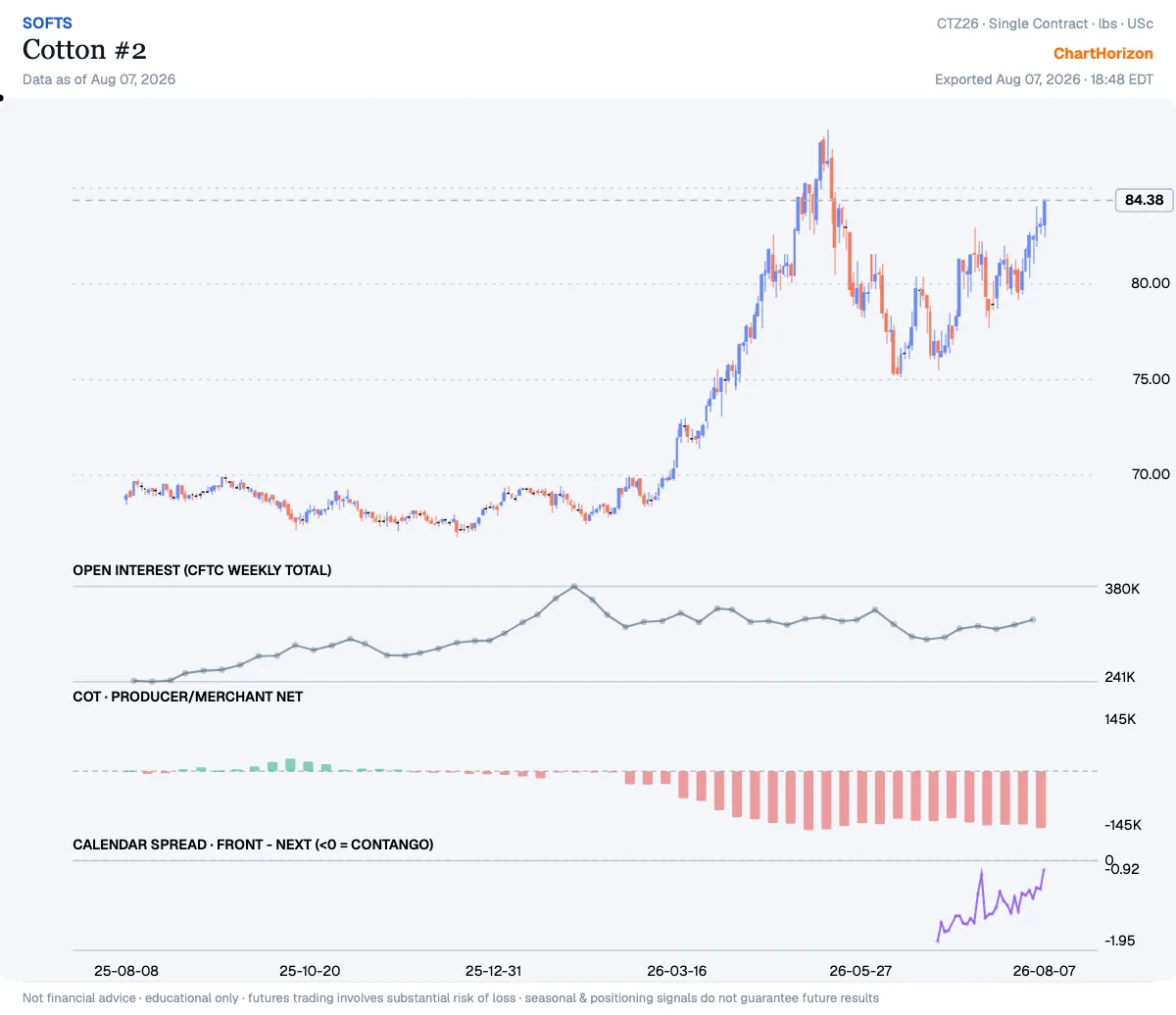
Cotton’s producer book sits at the 2nd percentile, net short 140,793 contracts — growers hedged hard into their own crop, an agricultural story with its own weather and its own arithmetic, not a macro signal.
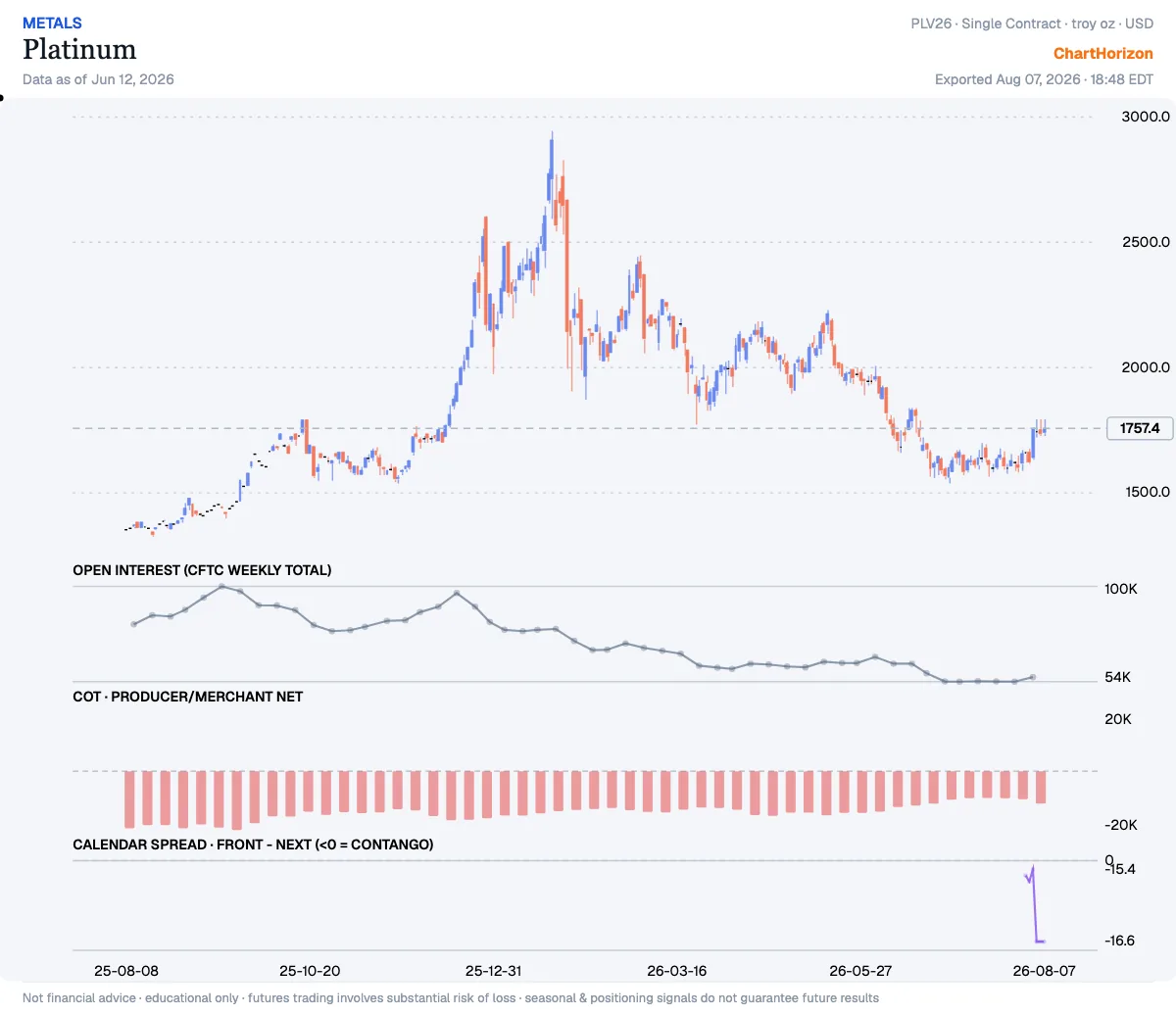
Platinum, like silver, has covered back to the least-short end of its three-year range at the 96th percentile. The metals lean the same way; the fibre leans hard the other.
Seven markets, four of them at fresh three-year extremes, and six of the seven new to that register this week. The tape does not reprice that many books at once very often, and when it does the sensible response is not to trade the headline but to write down what would prove it wrong.
Here is that note. If the labour market was the tell, the T-Note book gets paid, the dollar breaks under its recent range, and the miners’ reluctance to sell forward looks like foresight. If the three dissenters were the tell, then a record long in the Treasury complex meets a Fed that raises into a soft patch, and the most crowded hedge on the board becomes the most expensive one. The Dow short is the entry that resolves first either way, because it is the one facing a market at a record high with nothing but positioning against it.
The hedgers filed their view on Tuesday. The number that tests it arrived on Friday. What has not yet happened is the part where the price agrees — and until it does, this is a warning and not a verdict. There is no prize for guessing which, and no penalty whatever for reading the next report before deciding.
Informational and educational only — not financial advice. Futures trading involves substantial risk of loss; seasonal and positioning signals do not guarantee future results. Signals and charts: ChartHorizon (local end-of-day data).