The Bid of Last Resort
The 30-year yield touched 5.33 per cent, its highest since 2007, and the Treasury doubled its buybacks. The hedgers had been long since 11 August.
Prices through 19 August 2026 · COT through the 11 August report · a rates note · Data: ChartHorizon, CFTC & press reports · Charts: ChartHorizon
On Tuesday, 18 August, the yield on the thirty-year Treasury bond touched 5.33 per cent — the highest it has been since 2007. On Wednesday morning the Treasury announced it would at least double the size of its buybacks of long-dated debt. By the close the thirty-year future had put in the largest single up day of 2026, on 1,026,870 contracts — better than twice the average of the twenty sessions before it.
And the commercial hedgers in that contract had been sitting at the 92nd percentile of their three-year net long since the report dated 11 August. Eight days early.
That is the week. What follows is the argument about what it means, which is less obvious than the headline, and in one respect the opposite of it.
Only the long end was broken
The convenient story is that the bond market was in trouble. It was not. One part of it was.
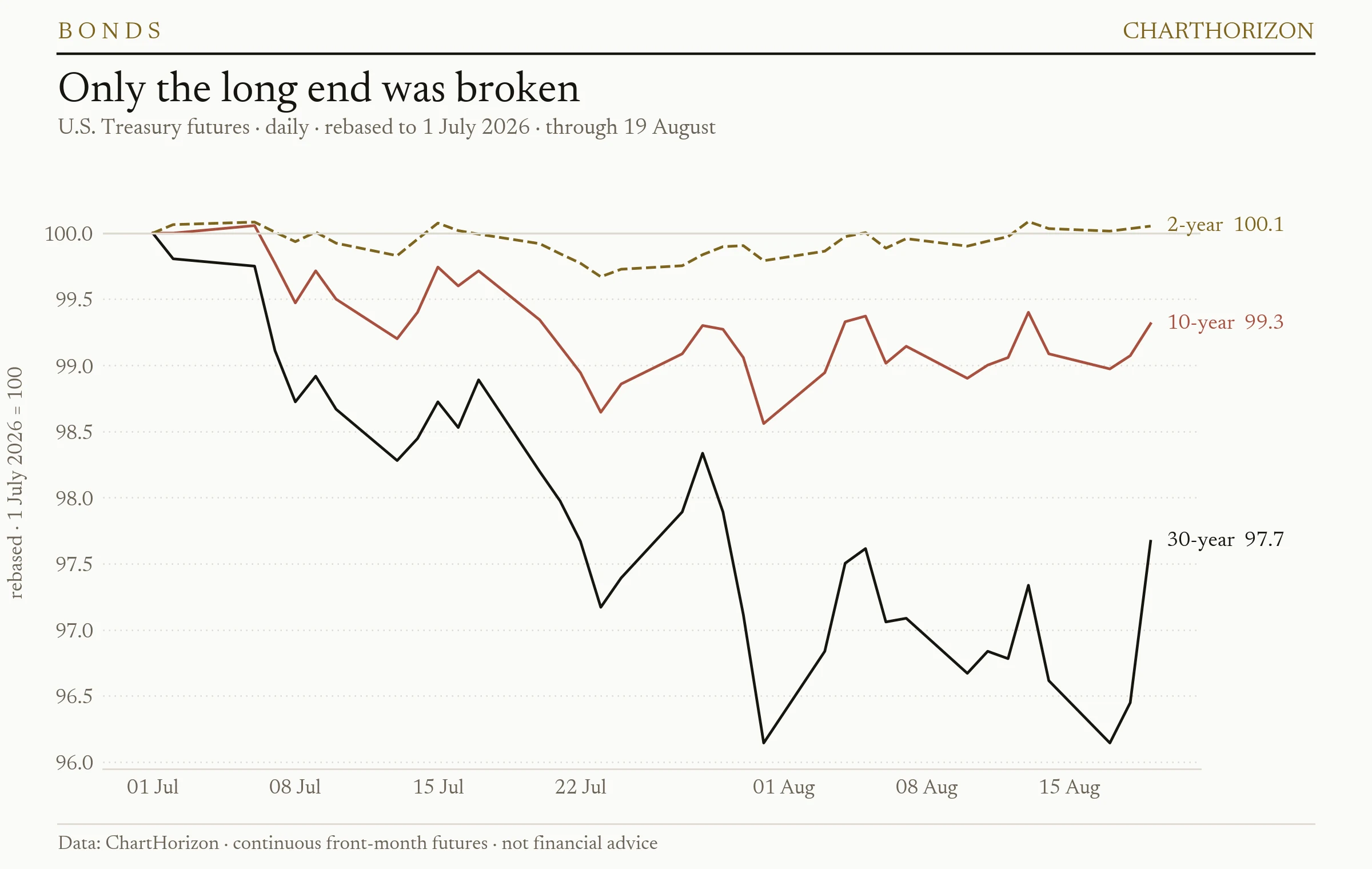
Take the lows. The two-year note bottomed at 102.68 on 23 July, and its next two troughs came in at 102.88 and 103.04 — higher, then higher again. The five-year did the same. The ten-year bottomed at 108.00 on 31 July, then 108.38, then 108.45. Every one of those is a market that has stopped falling.
The thirty-year bottomed at 108.31 on 31 July, rallied, and then went straight back down to 108.31 on 17 August. It did not make a higher low. It made the same low, a fortnight later, while everything shorter than it was quietly building a floor.
That distinction is the whole diagnosis, and it is worth being blunt about what it rules out. If this were a story about the Federal Reserve — about the path of the policy rate — the two-year would have been the casualty, because the two-year is the instrument that trades the Fed. The two-year was fine. What was failing was the market’s willingness to hold duration at any price, and that is a question about the supply of long bonds and the shrinking population of people who will warehouse them, not about the funds rate.
The Treasury’s response was addressed to exactly that. The expanded operations cover the ten-to-twenty-year and twenty-to-thirty-year sectors and nothing shorter. Whoever wrote the announcement had read the same chart.
Filed eight days early
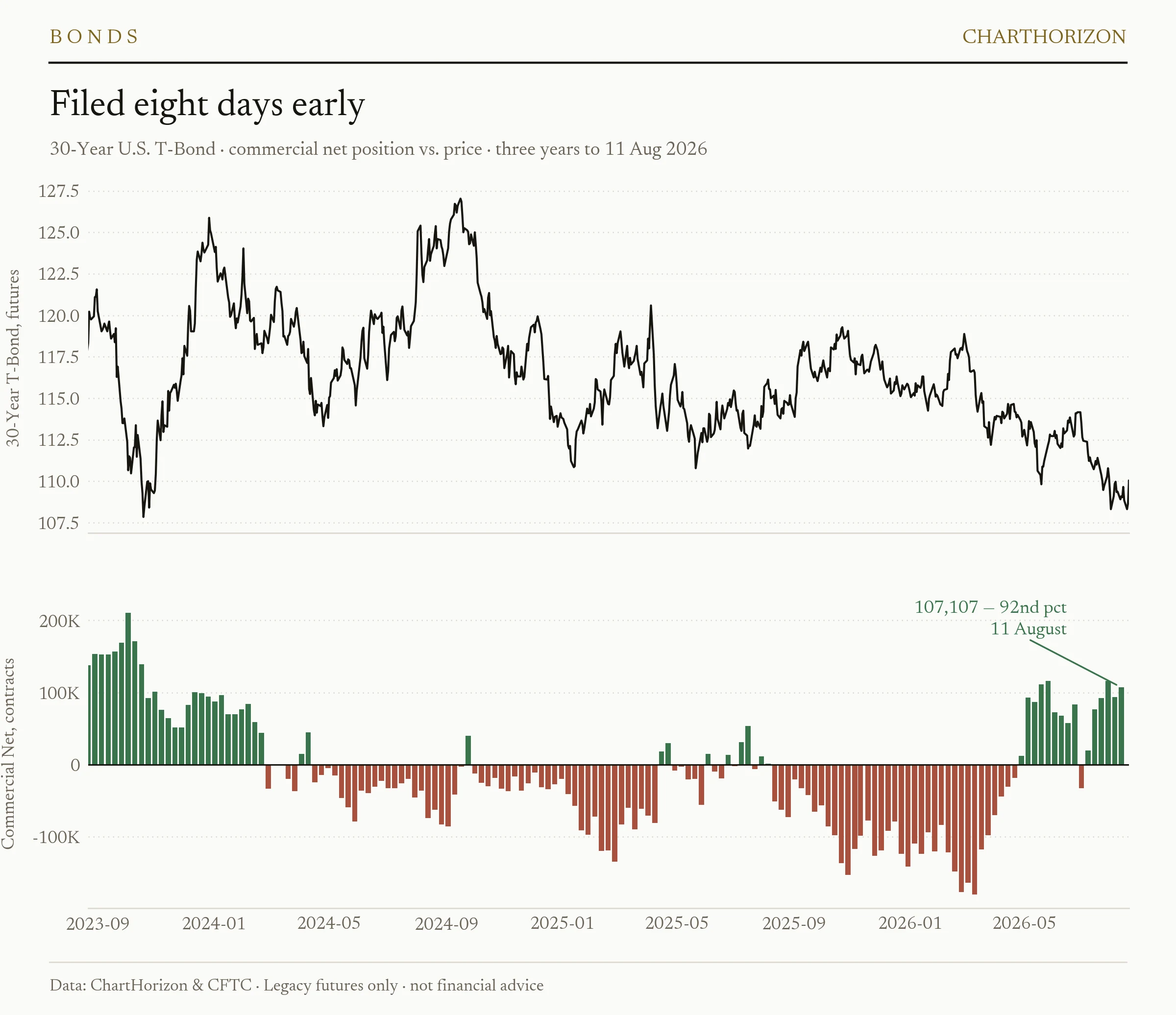
The Commitments of Traders report published last Friday carries a snapshot dated Tuesday, 11 August. On that date the commercial book in the thirty-year bond was net long 107,107 contracts — the 92nd percentile of its three-year range, and a straight inversion of where the same cohort sat five months ago, when on 10 March it was short 179,711, the deepest reading in the window.
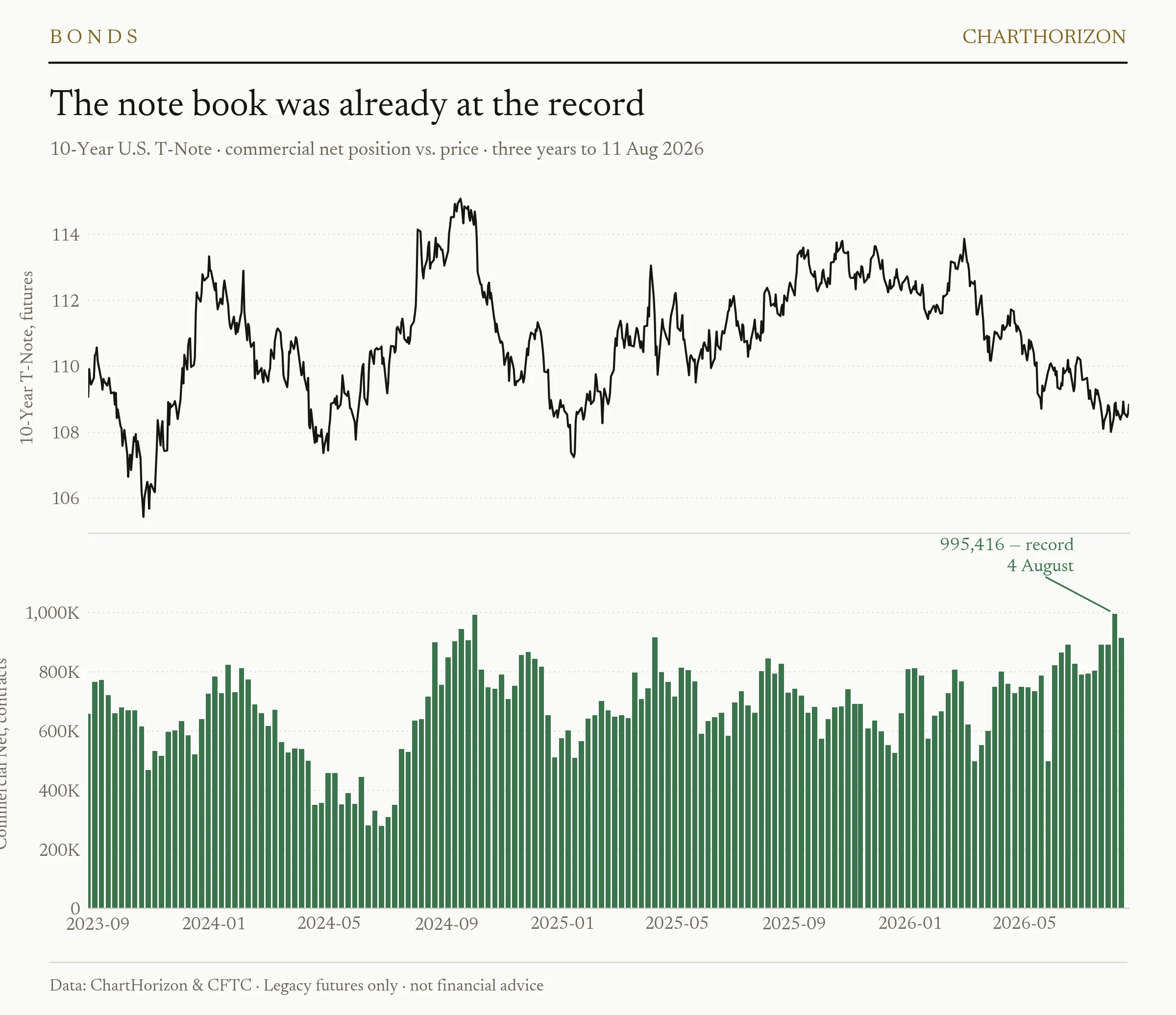
The ten-year is the louder half of it. Commercial Net there stands at 914,011 contracts, the 97th percentile — a shade under the 995,416 record printed a week earlier, on 4 August. That record is the same entry this paper wrote up on 8 August, when the note read: if the labour market was the tell, the T-Note book gets paid.
It got paid. It did not get paid by the labour market. It got paid by the Treasury’s debt manager, which is a different institution with different reasons, and the honest version of this week is that the right position was held for a reason that did not turn out to be the reason it worked. That happens more often than the genre admits, and a ledger that only records the times the thesis and the payoff matched is not a ledger.
What the positioning does establish is the thing the CFTC data is actually good for. These books were arranged before the announcement existed. Nobody in that report was front-running a press release; they were being paid to be protected from a long end that had stopped functioning, at a moment when the tape gave them every excuse to stand aside.
What the operation actually is
Here the arithmetic disagrees with the reaction, and it is not close.
The Treasury did not print money. It cannot. It has two sources of funds, taxes and borrowing, and a buyback is financed out of the second: the department issues new paper — overwhelmingly bills — and uses the proceeds to retire old bonds. No reserves are created. Nothing enters the banking system that was not already there. It is an Operation Twist run by the fiscal authority instead of the monetary one, and its entire effect is to shift the government’s financing burden toward the front of the curve, where there is still an appetite for it.
The size is smaller than the noise around it suggests. Individual operations go from a $2 billion maximum to a $4 billion minimum, and the number of long-end operations rises from two a quarter to four. Across the seven auctions scheduled between 9 September and 4 November, that is roughly $28 billion of buying where the old sizing would have delivered about $14 billion. Against a stock of roughly $10 trillion in outstanding notes and bonds of ten years and longer, the whole enlarged programme is on the order of 0.14 per cent — and the increase is half of that.
The economics of an individual trade are stranger still. Wednesday’s own operation took in $175 million face of a thirty-year bond carrying a 1.875 per cent coupon, at 52.4 cents on the dollar. The Treasury paid about $91.7 million for it. That money is borrowed at something close to 4 per cent. The government retired a bond paying 1.875 per cent and funded the purchase at roughly double that rate — so the operation reduces the principal outstanding and increases the annual interest bill, by something in the region of $400,000 on that one line. Wolf Richter has been the loudest voice making this point, and on the arithmetic he is right.
None of which makes the announcement empty. It is not designed to be arithmetic. It is designed to be a signal that somebody official is watching the long end and will show up — and it worked, because the thirty-year yield came off about fifteen basis points to the 5.18 per cent neighbourhood and the ten-year to 4.65 per cent. A bid of last resort does not have to be large. It has to be credible, and it has to be repeatable.
Whether it is repeatable is the open question, and this paper has a recent data point on how these things age. Three weeks ago Tokyo and Washington intervened jointly in the yen, the first time since 2011, and spent an estimated ¥8.45 trillion in a night. By 17 August the dollar was back at 159.21, within a yen and a half of where it started. Interventions buy days. What they cannot buy is a change in the reason the market was going the other way.
The other half of Wednesday
At two o’clock that afternoon the Federal Reserve published the minutes of its July meeting, and the American state finished the day having said two incompatible things in six hours.
The minutes record a 9–3 vote to hold, with Beth Hammack, Neel Kashkari and Lorie Logan each preferring a quarter point higher, and — the sentence that matters — that many participants assessed higher rates would likely be necessary if inflation did not fall. They also record Chair Warsh floating a cut in the number of annual meetings from eight to six, on the grounds that more information would accumulate between them. The Committee reached no conclusion and the 2026 calendar stands.
So: the fiscal authority spent the morning making long bonds easier to hold, and the monetary authority spent the afternoon explaining why rates might have to go up. Those are not contradictory in the technical sense — one is debt management, the other is policy — but they are read as one voice by anybody who is not paid to distinguish them, and on Wednesday almost nobody did.
What everything else did
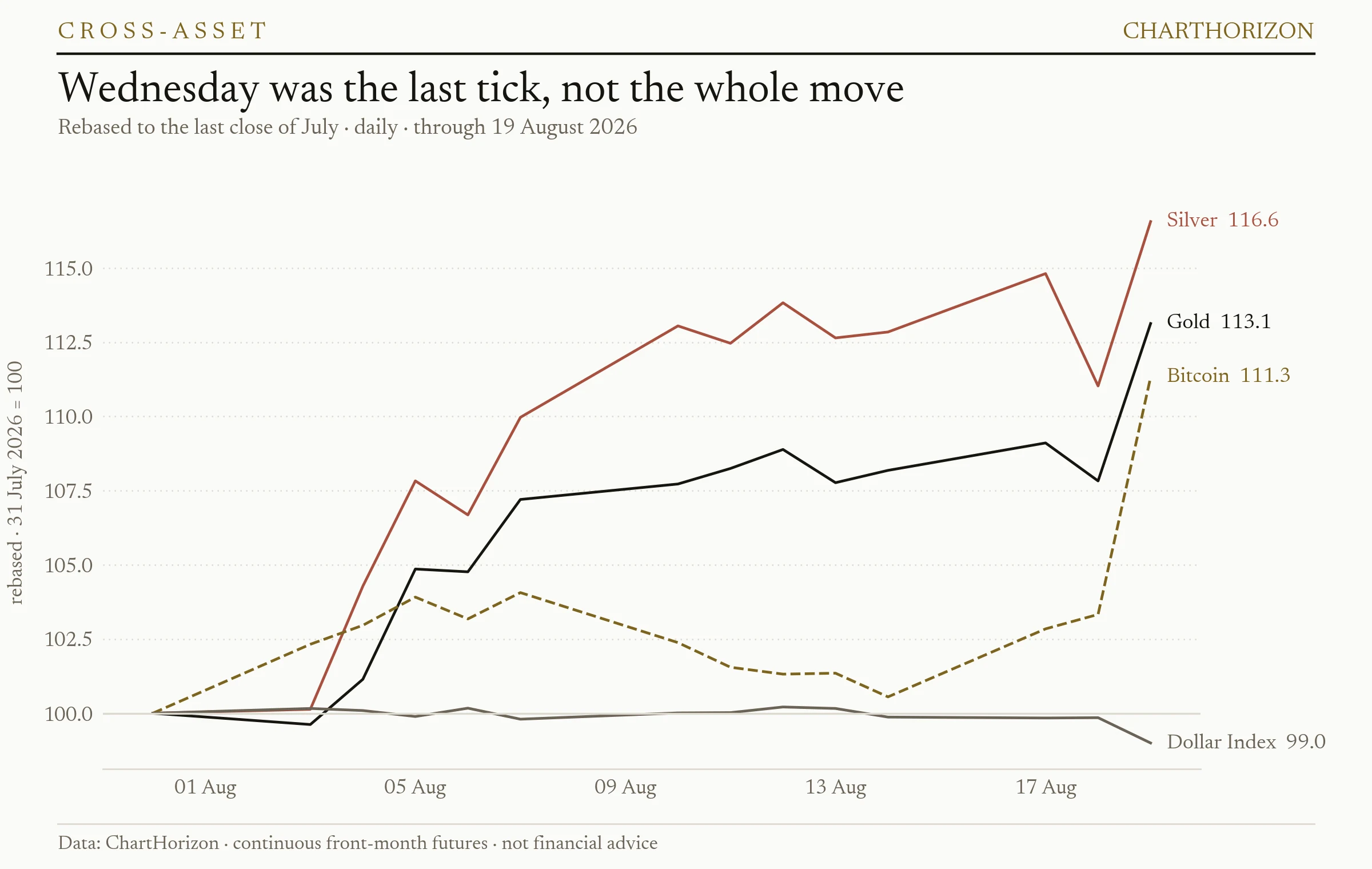
Silver closed Wednesday at $67.13 and gold in the neighbourhood of $4,520, each up about five per cent on the day. Bitcoin added close to eight per cent to $69,720, its highest since early June; The Block reported more than $1 billion of short positions liquidated inside an hour, spot bitcoin funds taking in $517 million and ether funds $189 million, the strongest day in months. Ether rose better than eighteen per cent to $2,275. The Dollar Index gave up about eight tenths of a per cent to 98.80. Equities barely moved.
The chart above is the reason to be careful with that list. Silver was already up more than eleven per cent on the month before Wednesday opened, and gold nearly eight. The metals have been repricing since the start of August, on cooling inflation and a market talking itself into an easier Fed, and Wednesday was the last tick of that move rather than the cause of it. Reading the whole month as a reaction to a buyback announcement gets the sequence backwards.
Bitcoin deserves its own sentence, because it is the one being narrated hardest. What happened on Wednesday was a squeeze: a billion dollars of shorts closed in an hour, into a session that also carried a proposed SEC framework for crypto offerings and a White House meeting with industry executives. That is three catalysts in one afternoon and a crowded short book underneath them. It is not a bull market. Bitcoin is down roughly forty-five per cent over twelve months and fifteen per cent over three, and a vertical day off a bond-market liquidity operation does not change either number. Call it what it was.
The note to write down
Three sentences, in order: the long end broke, the hedgers were already long it, the Treasury showed up. The first two are measured in this archive and the third is on the record.
What is not established is durability, and that is the entry to watch. If the buyback is what the Treasury says it is — a liquidity backstop for a plumbing problem — then the thirty-year holds above the 108.31 low that has now been tested twice, the ten-year keeps making higher lows, and the commercial book at the 92nd percentile turns out to have been early rather than wrong. If instead the long end was falling because the supply of long bonds exceeds the world’s appetite for them at 5 per cent, then $28 billion spread over seven auctions is a gesture, the yield goes back to test 5.33, and the most crowded hedge on the board becomes the most expensive one.
The tell will not be the metals and it certainly will not be bitcoin. It will be the second and third buyback operations in September, and whether the thirty-year needs them. A bid of last resort is only worth what it is worth the second time it is asked for.
Informational and educational only — not financial advice. Futures trading involves substantial risk of loss; seasonal and positioning signals do not guarantee future results. Signals and charts: ChartHorizon (local end-of-day data).