Who Sold Into It
Five softs rallied in the same week. The producer book went to the 6th percentile short in sugar and a three-year low in cotton — and barely moved in coffee.
Prices through 18 August 2026 · COT through the 11 August report · a positioning note · Data: ChartHorizon, CFTC, USDA & press reports · Charts: ChartHorizon
Every soft commodity on the board went up last week. Sugar added 4.4 per cent, cocoa 6.5, orange juice 5.5, coffee 8.2. Over three months the numbers are larger and in the same direction: cocoa up 55.8 per cent, coffee 31.6, sugar 18.6.
The people who grow these things did not treat that as one event. In two of those markets they sold forward about as hard as they ever have. In the other two they barely moved. The report that records this is dated Tuesday, 11 August, and the split in it is sharper than anything in the prices.
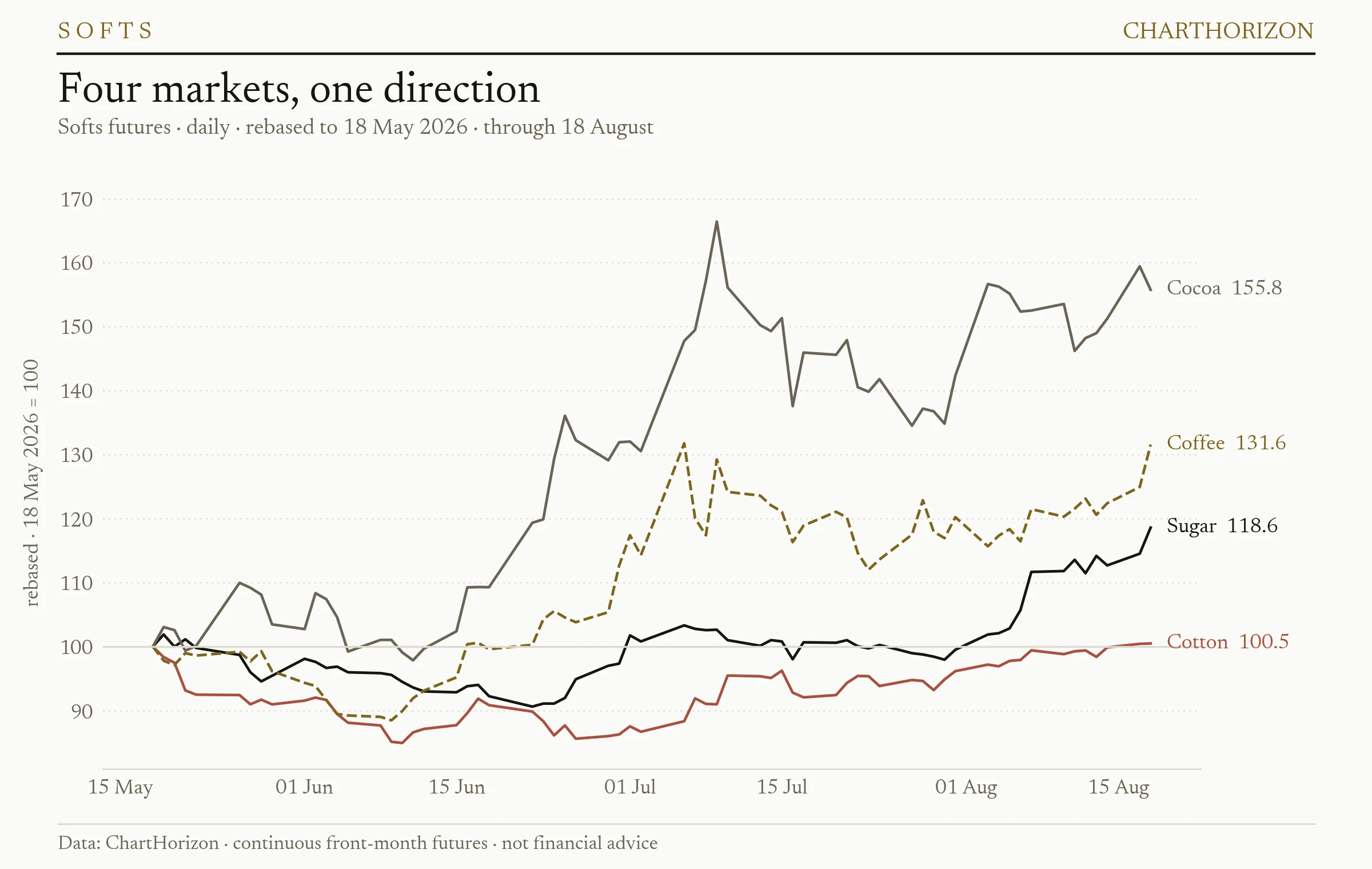
Where the price is at the top of its own year
Sugar #11 closed at 17.47 cents on 18 August. That is the highest it has traded in fifty-two weeks — not near the high, the high, with an intraday print of 17.59 behind it.
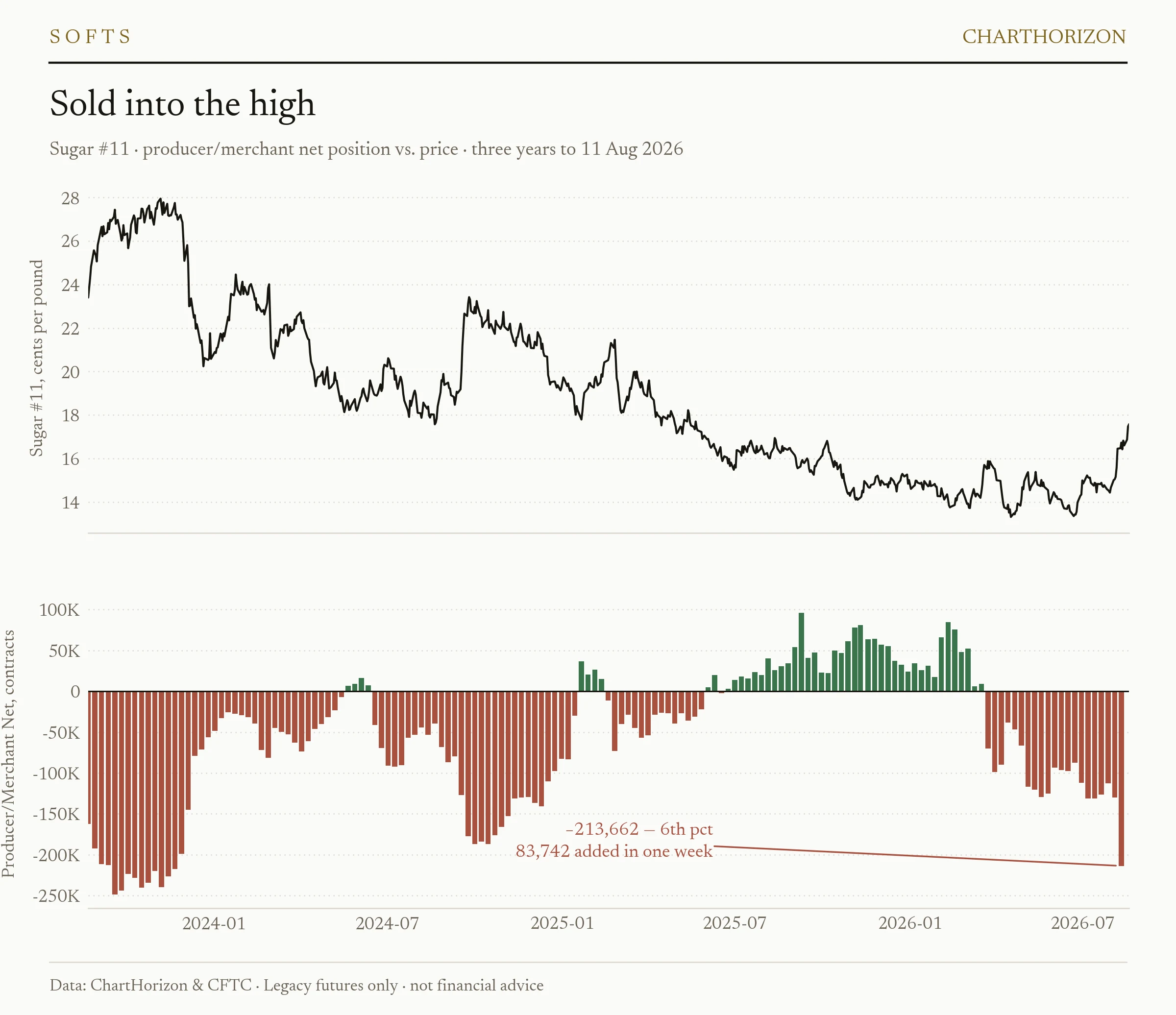
The producer and merchant book in sugar went from 129,920 contracts net short on 4 August to 213,662 on 11 August. That is 83,742 contracts of forward selling added in a single week, into a one-year high, and it puts the book at the 6th percentile of its three-year range — a hair off the most hedged that cohort has been since 2023. Open interest rose by 59,349 contracts over the same week, so this was new selling arriving, not old positions rearranging.
They had reasons that are already on the calendar. Unseasonably heavy rain in Brazil, tied to El Niño, has disrupted cane harvesting and milling; close to 58 per cent of cane juice went to ethanol in June, and Brasília raised the mandatory ethanol blend to 32 per cent in late July, which takes more cane away from sugar. In India the export ban is already in force, and Delhi is reported to be weighing a restriction on cane for ethanol from October, an earlier start to the crushing season, and duty-free imports — all of it aimed at containing record domestic prices before the festival season. Read those together and the picture is a market that is genuinely short of sugar now and has two governments actively scheduling the supply that ends it.
That is the situation in which a producer sells forward without hesitating. He is not calling a top. He is being handed a price he did not expect, in front of a supply response with a date on it.
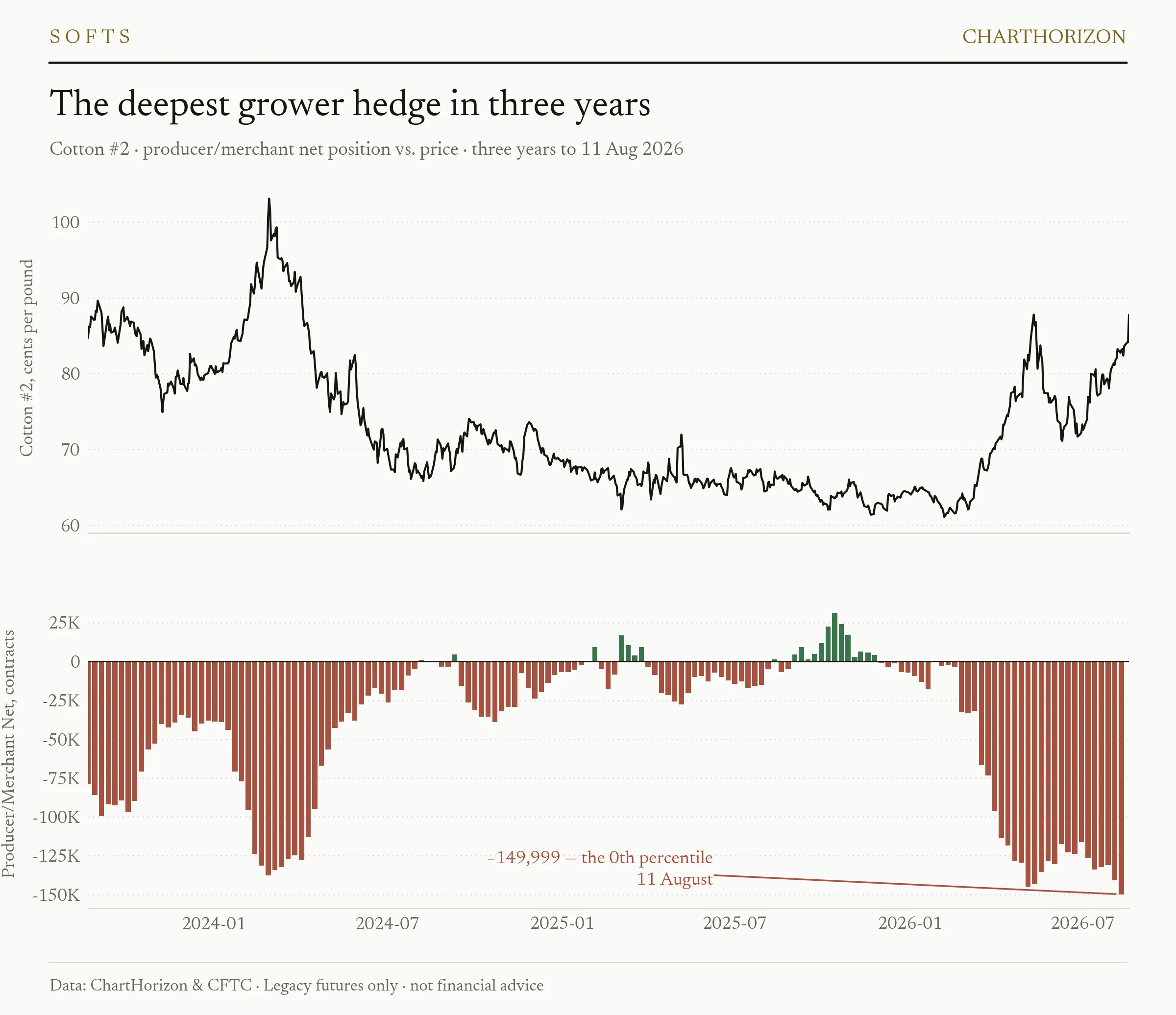
Cotton is the same behaviour from the opposite motive. At 84.12 cents the fibre sits at 86 per cent of its fifty-two-week range, and the growers’ book is net short 149,999 contracts — the lowest reading anywhere in the three-year window, 9,206 deeper than the week before. It is worth saying plainly that this is not an all-time record: the same book was short 178,783 in October
- Three years is the window this desk reads, and within it there is nothing lower.
The motive is the difference. The USDA’s August revision cut American production and raised world demand for the 2026 crop year to 122.92 million bales — a million above the July estimate and two million above last year — and reports of progress on US–China tariffs put a second bid under it, with heat in Xinjiang and worries about boll drop underneath that. But AgWeb’s reporting on the same rally makes the point that matters: American growers are still chasing break-even on the 2026 crop. Eighty-four cents is not a windfall to be sold at the top. It is the first price all year that pays the bills, and you lock in the first price that pays the bills.
Two record hedges, two entirely different reasons, and only one of them is a market call.
Where the price is halfway back from a collapse
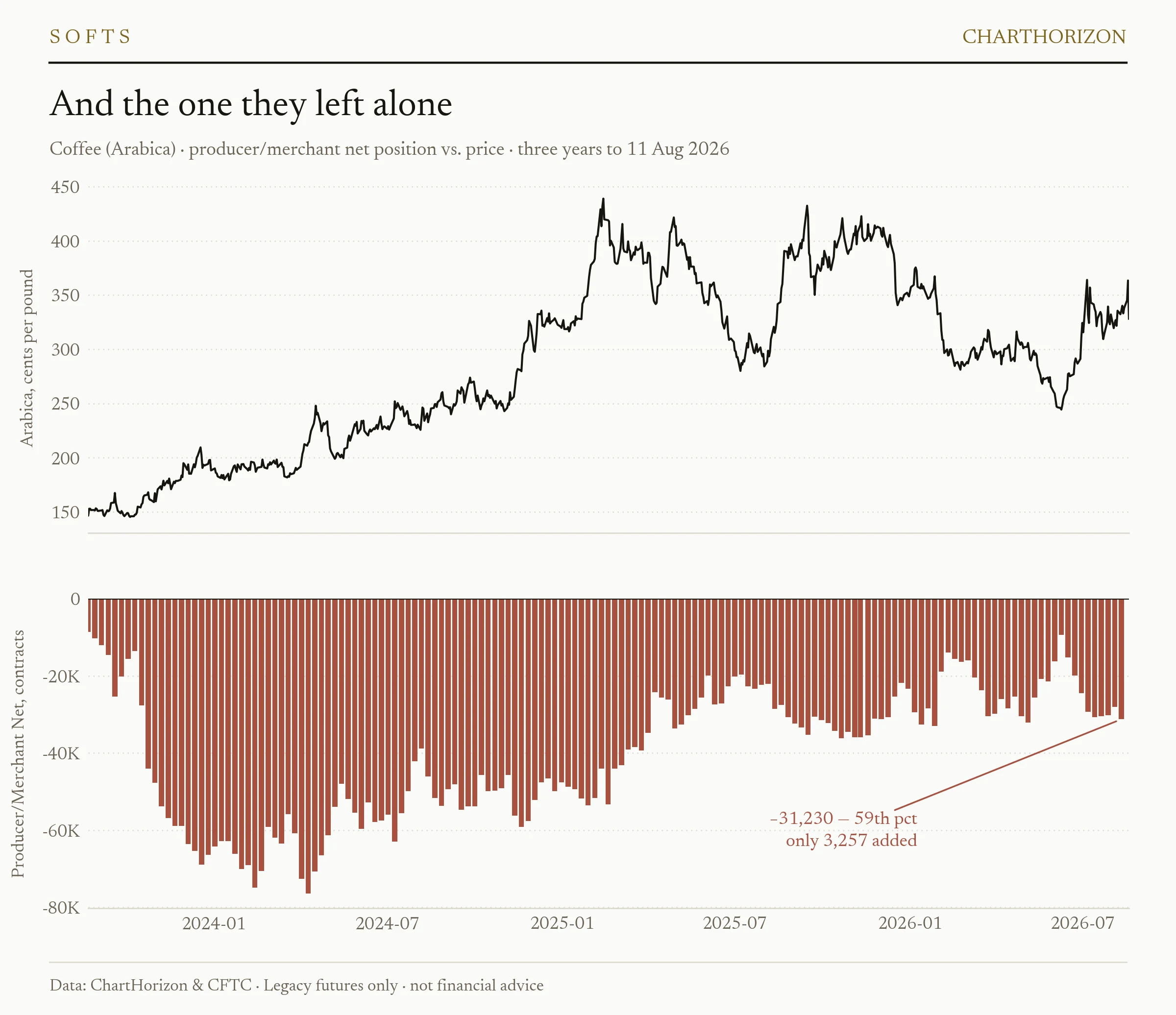
Coffee had the best week of the five, up 8.2 per cent to 363.40 cents, and its producer book moved by 3,257 contracts. Three thousand. The position sits at the 59th percentile of three years — squarely mid-range, which is to say: nothing happened here.
The reason is in the chart above it. Arabica’s fifty-two-week high is 432.35. At 363 the market is at 63 per cent of its own range, recovering from a June low rather than making a new high. And the supply argument is genuinely two-sided in a way sugar’s is not. ICE-certified stocks are around 242,700 bags, the lowest since late 2023, and Brazil’s harvest was 90 per cent complete on 12 August against 97 per cent a year earlier, with the arabica portion at 86 per cent against 95 — delays, in other words, that support the price. Against that, the Brazilian 2026/27 crop is a record one, and a record crop that is merely late is still a record crop. A grower looking at 363 cents with both of those on his desk is not obviously being offered a gift.
Cocoa says the same thing more loudly. It is up 55.8 per cent in three months and its producer book reduced its short by 432 contracts on the week, sitting at the 70th percentile. The context: cocoa is still down 28.3 per cent over twelve months and trades at 59 per cent of a range whose top is 8,047. Meanwhile arrivals at Ivory Coast’s ports are at their highest in three years — a bearish fact underneath a rallying price, and precisely the sort of thing that ought to produce heavy hedging if the growers thought the rally was the story. They are not selling it. They are treating five thousand nine hundred as a price on the way back from a wreck, not a price to be defended against.
The one nobody is bothering with
Orange juice rose 5.5 per cent on the week and remains the wreck itself: down 40.7 per cent over twelve months, sitting at 10 per cent of its fifty-two-week range, with a producer book at the 81st percentile — among the least hedged readings in three years, in a contract with barely ten thousand lots of open interest. Nobody is defending that price, because at these levels nobody needs to. It is in the table for completeness and as a reminder that a percentile is only as interesting as the market underneath it.
The note to write down
The reading here is not “softs are strong” and it is certainly not “the hedgers are bearish softs.” It is narrower and more useful than either. The producer book responds to where a price sits in its own history, not to how fast it is moving. Two markets at the top of their fifty-two-week range drew record-grade selling within a single week. Two markets recovering from a collapse drew almost none, in the same week, from the same kind of firm, under the same weather.
So the entries to watch are dated ones. Sugar’s supply answers have calendars attached — India’s crushing season from October, an ethanol blend already lifted to 32 per cent — and if the deficit outlasts them the 6th-percentile short was early rather than right. Cotton’s hedge is a break-even hedge, which means it does not need the price to fall to have been the correct trade, and it will not be unwound by good news. Coffee resolves on whichever wins between certified stocks at a three-year low and a record Brazilian crop that is merely late.
And the entry that would break this whole reading is a simple one: if coffee or cocoa take out their fifty-two-week highs and the producer book still does not move, then the frame above is wrong and something structural has changed in how those growers hedge. That is worth more than another week of price. There is no prize for guessing, and no penalty at all for reading the next report before deciding.
Informational and educational only — not financial advice. Futures trading involves substantial risk of loss; seasonal and positioning signals do not guarantee future results. Signals and charts: ChartHorizon (local end-of-day data).